
Smarter certified payroll audits
for total compliance.
Flag underpaid wages, misclassifications, and missing fringes
before any certified payroll report reaches the agency.
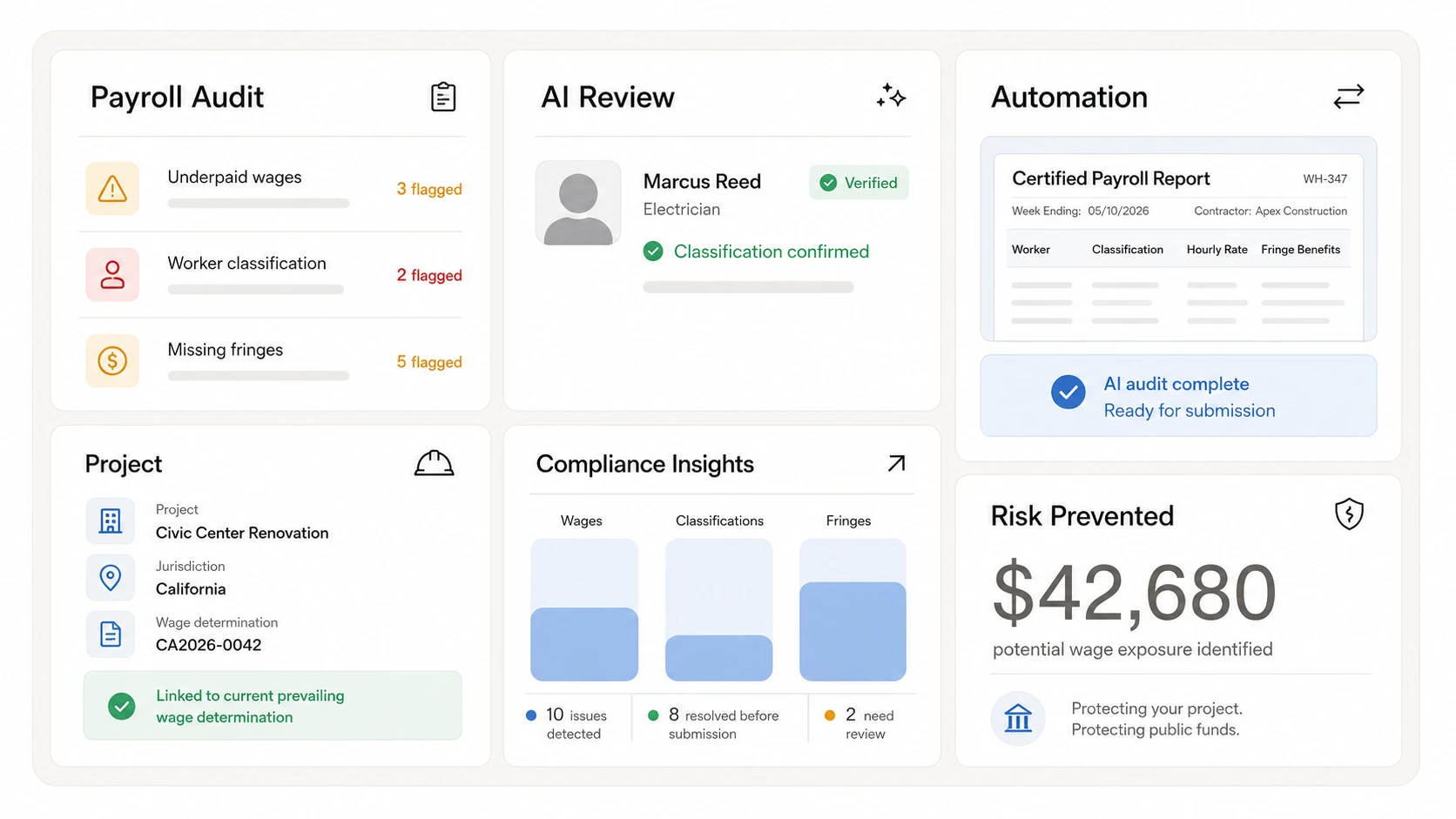
Guardrails you set once. Lock the wage determination and every payroll is checked against the right rates, classifications, and fringes.
Audits that run themselves. AI agents parse reports, classify workers, and reconcile rates against the determination, with no line-by-line review.
Compliance in real time. Instant visibility across every subcontractor, project, and pay period, so issues surface before a report is filed.
Every payroll, audited
in one platform.
Certified payroll, prevailing wage, apprenticeship, and Section 3 all run through Buildalytic, giving your compliance team full visibility and control in one place. You replace scattered spreadsheets and manual review, auditing every report from intake to filing.

Certified Payroll · WH-347
Week ending Jun 12, 2026
J. Alvarez
Electrician, Inside Wireman
$47.10
Determination is $52.30
R. Okafor
Laborer, Group 1
$38.50
M. Chen
Operating Engineer
$61.20
T. Nguyen
Apprentice, 1st period
$26.15
Fringe not paid
Catch every finding
before you file.
AI reads every WH-347 and state form at any scan quality and matches each worker’s classification, rate, and fringe to the governing wage determination for the trade, county, and project period. A deterministic rules engine then checks base rate, overtime, fringe, and apprentice ratios and returns underpayments, misclassifications, and short fringe as specific findings with the dollars owed and the restitution due each worker, scored and ready to resolve or hand to the agency. Your team reviews the exceptions, not every line.
Prevailing wage complianceCollect every sub’s
payroll, on time.
Today a controller collects every subcontractor’s certified payroll by hand, chases the late ones by email, and checks each report line by line. Buildalytic gives each sub a link to upload, tracks who has filed and who is late, chases the stragglers on a cadence, and audits what comes back, so your team assembles a complete, agency-ready package without the manual grind.
Collect subcontractor payrollsSubcontractor payrolls
Civic Center Renovation
Sierra Framing
Delta Electric
Vanguard Concrete
Reminder sent
Ironclad Steel
4 days late
Coastal Mechanical
Source · Wage determination
CA-2026-0042
Effective Jun 1, 2026Sacramento County
Electrician, Inside Wireman
Base rate
$52.30
Fringe
$18.10
Total
$70.40
Every finding cites
its source.
Each flag links to the exact wage determination line it came from: the craft, the base rate, the fringe, and the effective date. You can defend the audit, not just trust it, and resolve, release, or assemble an agency-ready packet in a click.
Built to be trusted
AI reads the report.
Deterministic rules make the call.
Same report in, same result out, every time, so every finding is exact, reproducible, and easy to defend.
AI reads and structures
Any WH-347 or state form, at any layout or scan quality. AI pulls every worker, classification, rate, fringe, and deduction from documents a rigid parser cannot handle.
Deterministic rules decide
Rates, fringe, overtime, and apprentice ratios are checked against the governing determination, not a model. The same report always produces the same finding, with the source behind it.
“The Wage and Hour Division will not tolerate any contractors who falsify certified payroll records and will hold them accountable.”
Falsifying certified payroll on federal work can bring back wages, penalties, and a three-year bar from federal contracts. U.S. Department of Labor, 2024
Certified payroll audit FAQ
The questions contractors ask most about certified payroll audits.
A certified payroll audit checks a WH-347 or state certified payroll report against the applicable prevailing wage determination to confirm every worker is paid the correct base rate and fringe for the right classification. Buildalytic reads the report, classifies each worker, pulls the governing determination, and flags the exceptions before the report is submitted.
Yes. It ingests the federal WH-347 and state-specific certified payroll formats at any layout or scan quality, and extracts workers, hours, classifications, base rate, fringe, and deductions, including cash-in-lieu and on-check fringe. Your team does not reformat anything before uploading.
Each worker is classified and matched to the correct prevailing wage determination for the trade, county, and project period. Rates are checked against that determination, and every finding links back to the exact source line, so a reviewer can confirm it rather than trust it.
Underpaid base rates, misclassifications, short or missing fringe, overtime errors, apprentice-ratio problems, and an incomplete statement of compliance. Each exception comes back as a specific finding with the dollars owed, scored and ready to resolve, release, or assemble into an agency audit packet.
The finding comes with the back wages, or restitution, owed to each affected worker, calculated from the gap between what was paid and the governing wage determination. You get the amount per worker and the supporting math, so you can pay the restitution, correct the report, and document that the worker was made whole before the agency asks.
Both, by design. AI reads and structures the reports, including messy scans and nonstandard state forms a rigid parser cannot handle. The compliance decision, comparing each rate and fringe to the governing determination, runs on a deterministic rules engine, so the same report always produces the same finding. The AI does not guess at your numbers.
Yes, because the judgment is not left to a model. Extraction is AI; the audit itself is deterministic and reproducible, and every finding links to the exact wage determination line behind it, so a reviewer confirms rather than trusts. Human review and approval steps are built into the workflow.
Yes. AI agents read and classify workers, match determinations, collect subcontractor payrolls, and chase what is late. They do the legwork and surface the flagged exceptions, so your team reviews what needs a human instead of every line.
Yes. It gives each subcontractor a link to upload, tracks who has filed and who is late, and sends reminders on a set cadence, so you assemble a complete package without chasing subs by email. You stay covered for their payrolls, not just your own.
No. Buildalytic is a review and audit layer on top of what you already file. It reads the reports you collect or export, audits them against the determination, and hands back findings. You keep filing where you file today, and the audit runs before submission.
Yes. Every finding cites the wage determination line it came from, the craft, base rate, fringe, and effective date, so you can show your work. Findings can be resolved, released, or packaged into an agency-ready audit file.
No. We do not store Social Security numbers, and we never use your data to train shared models or share it across customers. Certified payroll data is isolated to your organization, encrypted in transit and at rest, hosted in the US, and yours to export or delete at any time.
Keep reading
- Compliance platformComing soon
- Prevailing wage compliance
- Collect subcontractor payrolls
- What is certified payrollComing soon
- Automate certified payrollComing soon