
The right prevailing wage,
on every check.
Prevailing wage compliance without the guesswork: the exact Davis-Bacon or state determination, the right classification, and the right fringe credit, applied automatically on every public works job.
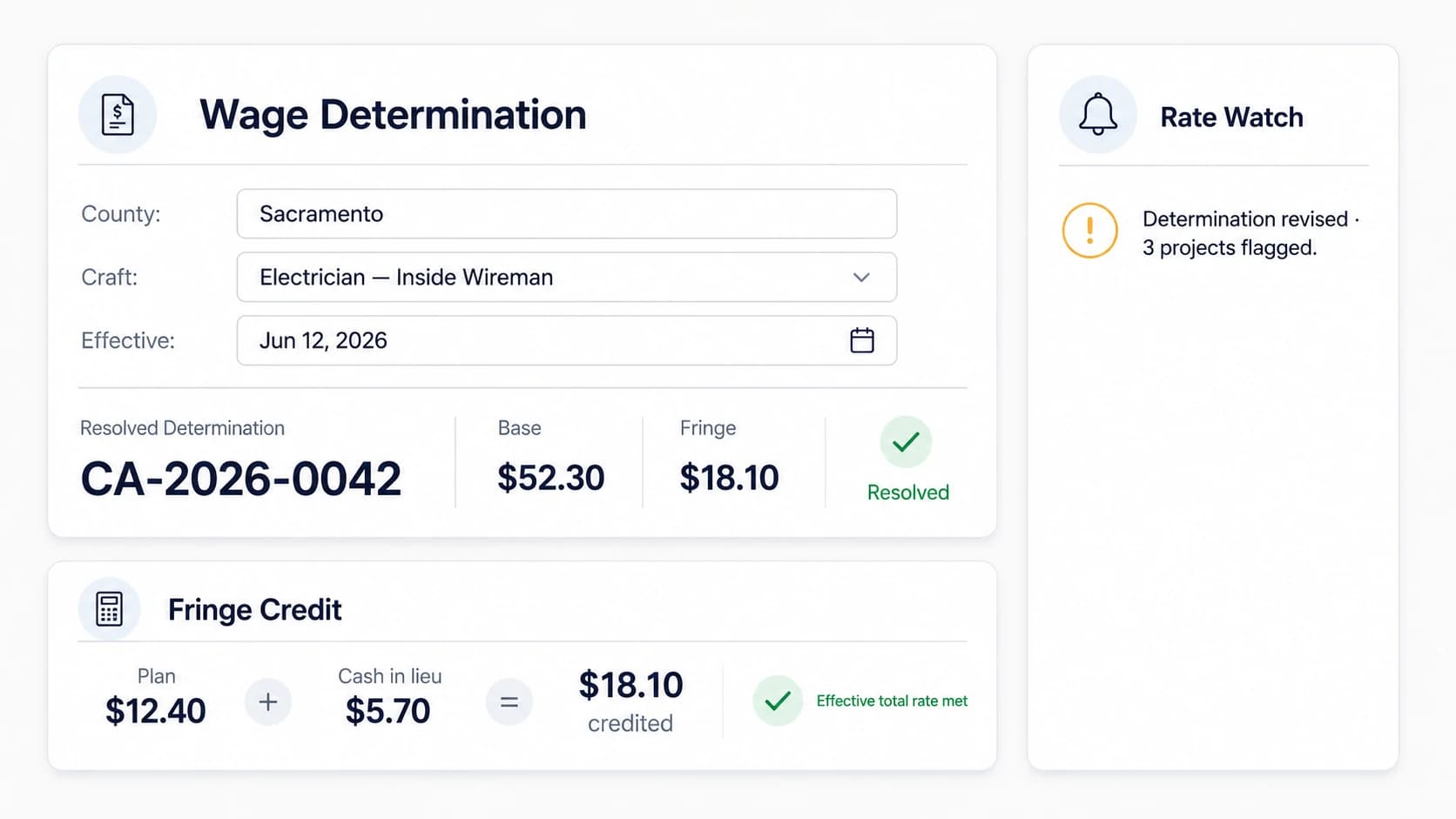
Rates that are never stale. Federal Davis-Bacon and state determinations, including California DIR, kept current, so you never pay off an expired sheet.
County and craft, resolved exactly. The determination resolves from county, craft, and date, with zone and area rules applied, not a nearest-match guess.
Fringe that reconciles. Cash in lieu and plan contributions reconcile against the effective total rate, so credits are counted once and correctly.
Coverage
Federal Davis-Bacon in all 50 states.
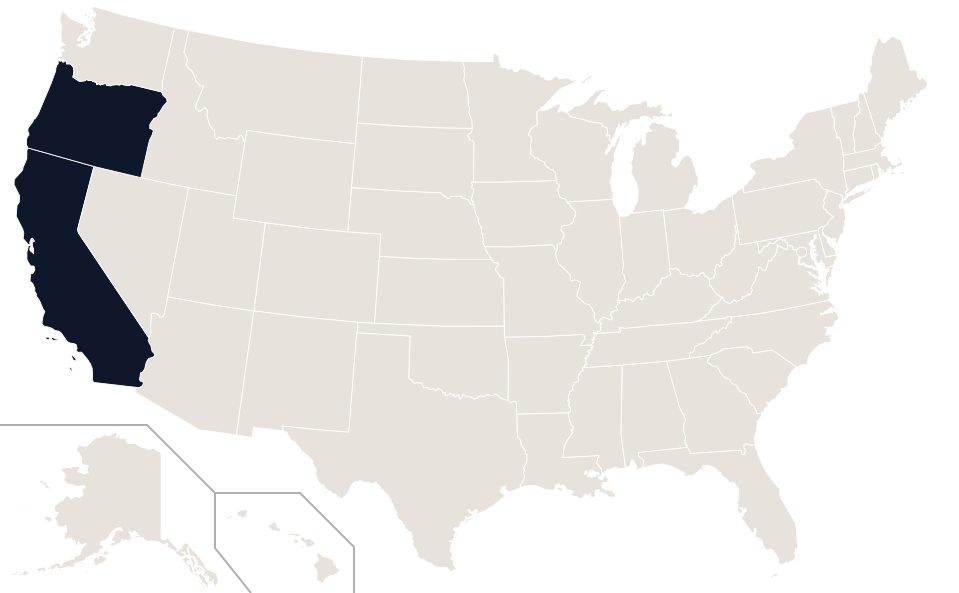
Every federally funded public works job is covered nationwide. State prevailing wage is live for California and Oregon, and we add new states as you win work in them.
Wage determination
Base rate
$52.30
Fringe
$18.10
Total
$70.40
Resolved from county,
craft, and date.
Instead of a payroll admin looking up the right sheet by hand, every worker is classified for the project and the determination resolves from county, craft, and date, with zone and area rules applied. Not a nearest-match guess, one determination, with the source cited on every line.
How determinations workComing soonFringe credits, counted
once and correctly.
Cash in lieu and bona-fide plan contributions reconcile against the effective total rate, so a plan contribution is never counted twice and never left short. The math the agency checks in an audit is the math you paid.
Certified payroll auditFringe credit · effective total rate
Electrician, Inside Wireman
Counted once, no double credit
Determination revised
CA-2026-0042 → Modification 2, effective Jul 1, 2026
When a determination
changes, you know first.
We watch the federal and state determinations continuously, so the moment one affecting an active project is revised, you are flagged and rates update before the next pay period, not after an underpayment is already out the door.
Prevailing wage calculatorComing soon“The U.S. Department of Labor will enforce prevailing wage requirements on federal contracts to prevent contractors from gaining an unfair advantage over employers who abide by the law.”
Willful prevailing wage violations can bring back wages, penalties, and debarment from federal contracts. U.S. Department of Labor, 2021
Prevailing wage FAQ
The questions contractors ask most about prevailing wage.
A government agency surveys wages paid for each construction classification in a geographic area and publishes a determination with a base rate and fringe. Federal determinations come from the Department of Labor; states like California publish their own through the DIR. The rate applies to covered public work in that area.
Minimum wage is a legal floor for all workers. Prevailing wage is a higher, classification-specific rate that must be paid on covered public construction, set by the type of work and the location. It includes a base hourly rate plus a fringe benefit amount, and it varies by craft and county.
Davis-Bacon is the federal prevailing wage law, covering federally funded construction contracts over $2,000. Prevailing wage is the general term, and many states have their own laws that apply to state and local public work. A job can be covered by federal Davis-Bacon, a state law, or both.
A wage determination lists construction classifications with a base hourly rate and a separate fringe amount for each. You find your worker’s classification, apply the base rate plus fringe, and follow any footnotes for zones or special conditions. The determination in effect for your project period is the one that governs.
Federal Davis-Bacon determinations are revised periodically as the Department of Labor issues modifications. California DIR issues general determinations on a semi-annual cycle, with predetermined increases built in. The rate locked to your project depends on the award date and the determination in effect at that time.
Federal Davis-Bacon prevailing wage is covered in all 50 states, so any federally funded public works job is supported nationwide. State prevailing wage is live for California (DIR) and Oregon (BOLI), and we add new states as customers win work in them.
Penalties include back wages owed to underpaid workers plus civil penalties. In California, penalties can reach $200 per day per underpaid worker under Labor Code 1775, and payments can be withheld. On federal work, willful violations can lead to debarment from future contracts.
No. We do not store Social Security numbers, and we never use your data to train shared models or share it across customers. Payroll and wage data is isolated to your organization, encrypted in transit and at rest, hosted in the US, and yours to export or delete at any time.
Keep reading
- Compliance platformComing soon
- Certified payroll audit
- Apprenticeship compliance
- Prevailing wage and Davis-BaconComing soon
- Pass prevailing wage auditsComing soon