
Compare approaches
Five ways to handle field communication in construction.
Contractors handle calls and texts with crews, subs, suppliers and customers in five common ways. A coordinator, an answering service, a texting app, a business phone system or an AI teammate like Brody. This guide compares what each one does well and when it fits.
Written by Buildalytic, the company that makes Brody.
The short answer
What is the best way to handle field communication? It depends on who does the follow up.
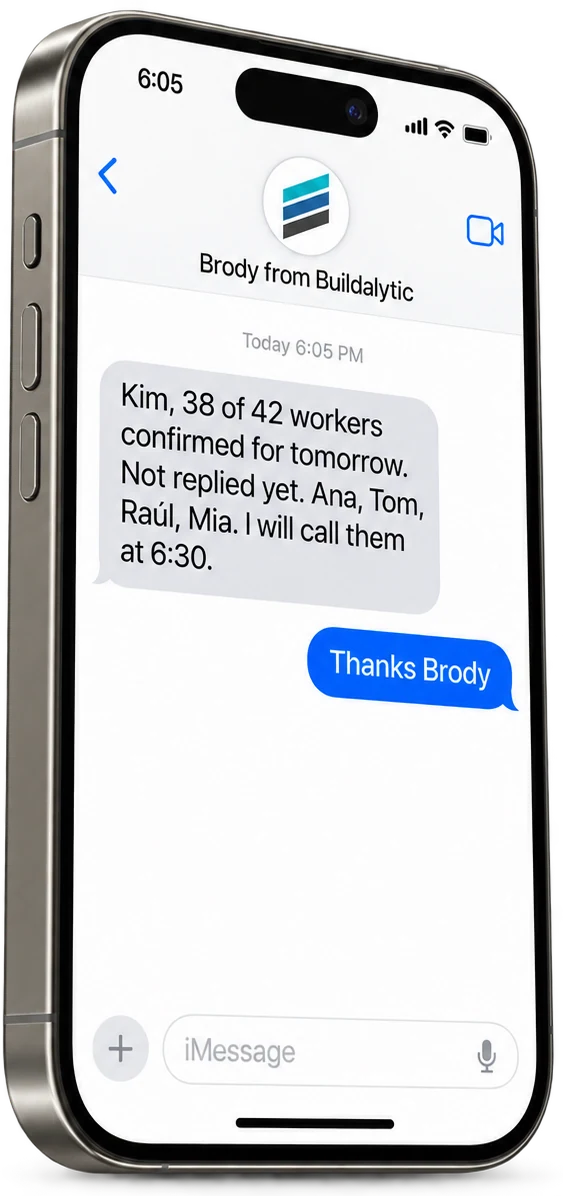
Most options connect people or take messages, and someone on your team still makes the follow up calls and updates the records. Brody does that follow up himself on your company number and files each answer to the job.
Field communication in construction is mostly outbound and repetitive. Who is on site tomorrow, did the sub confirm, where is the COI, is the daily in. The right setup depends on how many of those calls your team makes and who has time to make them.
Brody by Buildalytic is the AI teammate for construction. One company number answers and makes calls, texts and emails with crews, subcontractors, suppliers and customers in their own language, and updates Procore, Vista, SharePoint and OneDrive.
Side by side
How do the five approaches compare? Approach by approach.
One full Platform plan at $99 per operating user per month, or $89 per user per month billed annually. Start with one paid user. Standard setup is free.
| Approach | What it is | What it does well | Watch outs | Fits when |
|---|---|---|---|---|
| An intern or project coordinator | A person in the office who makes the calls, sends the texts and updates the records. | Judgment, relationships and handling the unusual call. | Limited to working hours. Follow up depends on one person’s time, and knowledge can leave with them. | You have a small number of jobs and someone with time to own the follow up. |
| An answering service | A human or AI receptionist service that answers calls and passes on messages. | Calls answered after hours and when the office is busy. | Most of the work starts after the message. Check whether the service makes outbound calls or updates your records. | Your main gap is inbound calls from customers. |
| A texting app or shared number | A business number with a shared inbox for calls and texts. | One number for the team, with the history in one place. | People still send every text and chase every reply by hand. | Your team wants a shared number and is happy to handle each conversation. |
| A business phone system | Extensions, ring groups, voicemail, mobile and desktop calling, often with video meetings. | Connecting callers to the right person in the office. | It connects people. It does not run dailies, sub follow up or crew dispatch, so check each vendor’s current AI features. | You need office calling and meetings, and the field follow up is already covered. |
| Brody by Buildalytic | An AI teammate for construction on one company number for office and field. | Answers and makes calls, texts and emails in each person’s language, then updates Procore, Vista and your records. | Brody is an AI assistant, so callers who want a person are transferred to your team. Built for construction, not other industries. | One full Platform plan at $99 per operating user per month, or $89 per user per month billed annually. Start with one paid user. Standard setup is free. |
Written by Buildalytic, the company that makes Brody. Products in each category differ, so check each vendor's current plans and features before you decide.
Before you choose
What should you ask before you choose? Six questions.
Ask who makes the follow up calls, where the answers end up, and whether crews, subs and suppliers can reach you from any phone in their language.
Who makes the follow up calls?
Count the outbound calls and texts your team makes each day, and who makes them.
Where do the answers end up?
A message in an inbox still needs someone to file it to the job.
Can the field reach you easily?
Crews and subs should be able to call or text from any phone, with no app.
Does it speak each crew’s language?
Instructions land better in the language a worker prefers.
What happens after hours?
Storms, pours and early starts do not wait for the office to open.
How is it priced?
Per user, per minute, per call or per company. Check each vendor’s current plans.
Combining approaches
Can you use more than one? Most teams do.
Keep people on the calls that need judgment and let Brody take the repetitive calls and texts. Brody can start on one workflow next to the phones and services you use today.
Coordinator plus Brody
Brody sends the dispatch texts, chases replies and takes the dailies, and the coordinator handles the exceptions he flags.
Answering service plus Brody
Keep a live service for daytime customer calls and use Brody after hours and for outbound follow up with subs and crews.
Phone system plus Brody
Office phone access is included in each paid operating user. There is no separate office-seat surcharge. Each user contributes to the company calling pools.
Brody on his own
On the Platform, one company number covers office calling, the field line and the follow up, with every answer on the job.
What is the best way to communicate with field crews?
Text is how most crews work, because it reaches any phone without an app. The best setup sends each person the message they need in their language, tracks who replied and follows up with anyone who did not, then keeps the answer on the job record.
Should we hire a project coordinator or use software?
Many teams do both. A coordinator brings judgment and relationships, and software takes the repetitive calls and texts so that person can spend time on the work that needs a human. Start by listing the calls your team makes every day and which of them follow a pattern.
Is an answering service enough for a construction company?
It can be if your main gap is inbound calls from customers. Most construction phone work is outbound, such as chasing subs, collecting COIs and confirming crews, so check whether the service makes those calls and where the results end up.
Can we combine these options?
Yes. A common setup is a coordinator for judgment calls, a phone system for the office and Brody for the repetitive calls and texts with crews, subs and suppliers. Brody can start on one workflow next to what you use today.
How does Brody fit with the people we already have?
Brody takes the routine follow up and files the answers to the job, then hands anything unusual to your team. Your PMs, supers and coordinators set the rules in plain language and stay in charge of the decisions.
How should we compare the options?
Run a 14 day evaluation on one real project with one workflow, next to your current setup. Compare what your team had to do by hand with what each option handled and recorded.
See Buildalytic in action.
See Brody handle your calls, texts and follow-up. Then start with one project, using your number, rules and records.
One full Platform plan. No standard setup fee. Start with one supported workflow.
Plan your rollout
Pricing, security reviews, procurement and rollout across your projects and regions.