
Private models
Private AI models for construction. Post-trained on approved work. Scoped to your tasks.
The standard Platform run in Buildalytic’s hosted cloud. Private-model post-training, dedicated model serving and customer-cloud or customer-server deployments are separately scoped Enterprise work with approved charges. Agree the authorized data, model licenses, evaluation and full training, inference, carrier and speech data paths before work begins.
Your company approves the training scope. Model-weight rights and licenses are agreed in writing. Your data never trains models for other companies.
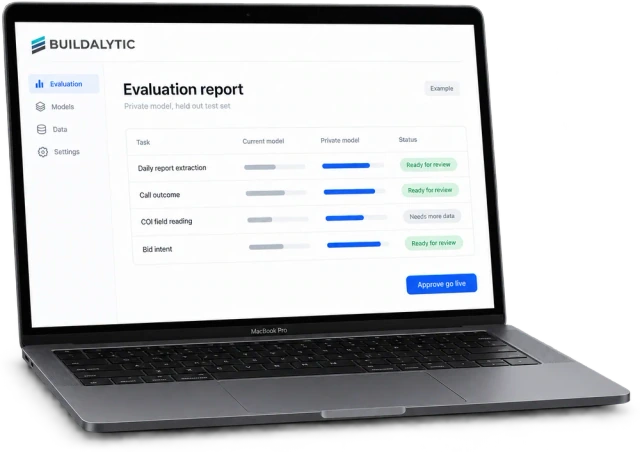
Your approval defines the training data. Every report a PM edits and every call outcome your office fixes shows the model what right looks like at your company.
How post-training works
Five stages, each one measured. How does Buildalytic post-train a private model?
First agree the permitted task, dataset, exclusions, model licenses and quote. Then prepare reviewed examples, evaluate a trained model against a held out set and seek approval for any routing change. Further training and compute must remain within the authorized scope.
Data
Your company selects and authorizes reviewed examples. Exclude partner-platform data and other restricted material, document permitted sources and reserve a held out evaluation set.
Training
Apply the approved training method to the permitted dataset. Training runs, providers, GPU capacity and costs are part of the agreed Enterprise scope.
Evaluation
The model is scored on held out, authorized examples it never saw in training, side by side with the model you use today.
Deployment
Your team reviews results against the agreed acceptance criteria before a task changes models. The serving location and external providers must match the written deployment plan.
Continuous improvement
Retraining, new datasets, workflow changes and evaluation reports follow the agreed cadence and compute budget. New data is not automatically admitted to training.
Measured on your work. Evaluate each agreed task against the current model and require your team’s approval before changing routing.
Where it runsWhat we post-train for
Narrow tasks, done your way. Which construction tasks can a private model learn?
We post-train for specific, repeated construction tasks where your team already reviews the output, so there is a clear right answer to learn from and to test against.
Daily report extraction
Turn a super’s end of day call into your daily report format, with crew counts, work done, deliveries, delays and inspections in the right fields.
Call outcome and intent
Classify what a call was about and how it ended, such as confirmed, rescheduled, needs a PM or no answer, using the outcomes your office uses.
COI field reading
Read certificates of insurance and pull insurer, policy numbers, limits, dates and additional insured wording into the fields your team checks.
Bid intent
Read a sub’s reply to an invitation to bid and record whether they will bid, decline or need more information, in your own categories.
Routing
Send each call, text and email to the right person, job or workflow, following how your company actually splits work between offices and teams.
Summarization
Write call summaries, job updates and handoff notes in the length and tone your PMs edit toward, with your job names and shorthand.
Model routing
The right model for each task. Does a private model replace frontier models?
No. Brody routes each task between your private model and leading frontier models. Your model handles the tasks it was trained and tested on, and frontier models stay in use where they are stronger.
| Kind of work | Handled by | Why |
|---|---|---|
| High volume tasks your team reviews, such as report fields, call outcomes and COI fields | Your private model | It was trained on your reviewed examples and scored better on your test set. |
| Open ended reasoning, long documents and unusual requests | Leading frontier models | General models are stronger on broad reasoning than a model trained for narrow tasks. |
| New workflows without enough reviewed examples yet | Leading frontier models | They handle the task under the approved routing policy. Any later training dataset requires separate authorization. |
| Live voice on calls | Agreed speech and voice providers | We do not train voice models. Your private model improves understanding and writing. |
Where it runs
Separate the deployment and model decisions. Where does a private model run?
A private model’s serving environment is part of a separate Enterprise agreement. Confirm whether the agreed components run in hosted infrastructure, a dedicated customer cloud or customer-provided servers.
01Buildalytic cloud
The standard Platform include their published hosted-service scope. Private-model training, serving capacity and any additional infrastructure require a separate approved Enterprise quote.
02Private cloud
A separate agreement specifies the dedicated environment, provider, region, access, key management, model-serving capacity and support. No regional residency is implied by the product name.
03Your own servers with local AI
Only the agreed chatbot models, embeddings and document index run on customer-provided hardware. GPU requirements, installation, operations and support are separately scoped and quoted.
04Calls and texts in every mode
Phone calls and texts travel through carriers. Speech, voice AI and messaging providers may also process content. Your deployment review confirms which model and records run locally and what reaches each external provider.
Ownership and governance
Your approval controls training. Your data never trains models for other companies.
The training agreement defines weight ownership and licensing. It also identifies permitted sources, providers, retention and access. Your calls, reports and documents are never sold or used to train models for other companies.
Data from Procore and other partner platforms follows their rules and stays out of model training altogether.
Agreed model rights
Weight ownership, export, licenses and permitted uses are defined in your training agreement.
No shared training
Your data never trains models for other companies, in any deployment mode.
Your team approves go live
A model takes over a task only after it beats the current model and your team signs off.
Agreed review cadence
Evaluation and retraining reports follow the schedule and acceptance criteria in your agreement.
The facts
Private models. What do you get, and what does it cost?
Private models, post-training and dedicated serving capacity require a separate approved Enterprise quote. State the permitted dataset, evaluation, hosting, training and inference compute, support and reporting scope before work starts.
| What it is | An open-weight model post-trained on separately authorized, reviewed examples for an agreed construction task. Partner-platform data is excluded. |
| Who it is for | Larger contractors with many workers or calls, strict data rules, or local AI on their own servers. |
| Tasks | Daily report extraction, call outcome and intent, COI field reading, bid intent, routing and summarization, scoped to the tasks with enough reviewed data. |
| Training methods | Supervised fine-tuning or reinforcement learning only under the approved dataset, methods and compute scope. |
| Evaluation | Held out test sets built from your own work, scored before go live against the model you use today. |
| Model routing | Frontier models stay in use where they are stronger. Your model takes the tasks it was tested on. |
| Setup | Separate approved Enterprise quote for the agreed dataset, preparation, training and evaluation work. |
| Continuous improvement | Retraining, new tasks, reporting and compute budgets follow the approved Enterprise scope. |
| Hosting | Standard plan hosting does not include a private-model project or dedicated compute. Hosting, GPU model serving, inference usage, hardware and support are agreed and quoted separately. |
| Ownership | The training agreement defines weight rights and base-model licenses. Your data never trains models for other companies. |
| How to start | Identify a permitted task and dataset, then approve the Enterprise training, evaluation, deployment and compute scope before work begins. |
What is post-training, and how is it different from prompting a general model?
Post-training takes an open-weight model that already understands language and trains it further on a specific job. Prompting only tells a general model what you want each time. A post-trained model has learned your tasks, forms and wording from examples your own team reviewed, so it handles them the way your company does.
Which methods do you use to train a private model?
A separately approved training scope may use supervised fine-tuning and reinforcement learning on reviewed examples. The agreement identifies the permitted dataset, methods, provider, evaluation and compute charges. Loading a knowledge base or configuring a workflow does not itself authorize model training.
How do we know a private model is good enough before it goes live?
Before go live, we use permitted, separately approved examples for held out test sets that the model never sees during training. The private model is scored on those test sets against the model you use today. It takes over a task only when it does that task better on your own work, and your team approves each go live.
Who owns the model, and is our data used for other companies?
Your company retains its rights in its data. The separate training agreement defines model-weight ownership, licenses, access and permitted uses, including the base model’s license. Your data is never sold or used to train models for other companies. Data from Procore and other partner platforms stays out of model training.
Do you stop using frontier models once we have a private model?
No. Routing is agreed for the tasks and models your team approves. Frontier models can remain in use for tasks outside a private model’s evaluated scope. This service does not train voice models or replace carriers and speech providers. Review each external model and speech data path before activation.
Where can a private model run?
Standard Buildalytic plans are hosted services. A private model’s training and serving environment is separately scoped and quoted through Enterprise. The agreement specifies hosting, dedicated GPU capacity, model serving and inference, customer-provided hardware, storage, support and external services. Customer-cloud or customer-server processing covers only the components explicitly agreed.
What does a private model cost?
Private-model work is separately quoted through Enterprise. Agree data preparation, training and evaluation runs, serving capacity, inference usage, retraining cadence, reporting, hosting and support before work begins. These items are not automatically included in a standard plan. Charges and any usage limits require written approval before activation.
How much of our data do you need to start?
Start by identifying an agreed task and reviewing whether a permitted dataset is sufficient for evaluation. Existing calls, documents and corrections do not automatically become training data. Your company separately authorizes the dataset, exclusions, processing providers and training scope. If the evidence is insufficient, do not proceed with that training job.
Approved data. Measured results.
An AI model trained on how your company works.
Define the task, permitted data and evaluation first. Training and model serving begin only under your separate approved Enterprise agreement and compute scope.
One full Platform plan. No standard setup fee. Start with one supported workflow.
Plan your rollout
Pricing, security reviews, procurement and rollout across your projects and regions.