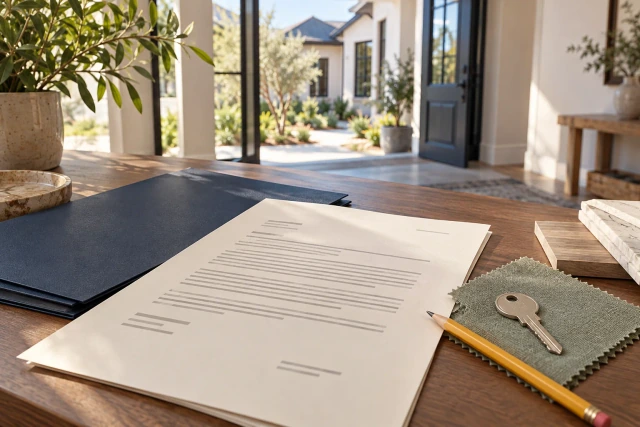
A construction warranty letter should identify its purpose, authorized issuer, project, covered scope, controlling warranty documents, source-backed dates, service contact and required review. Start by distinguishing an issuer’s warranty document from a homeowner’s repair request. Use the actual contract and warranty terms for coverage and notice requirements; a generic letter or handover date should not invent or extend them.
What to take away
- Choose whether you are preparing an issuer letter, collecting a trade warranty or requesting a repair.
- Trace every coverage statement and date to the applicable document.
- Keep preparation, authorized issue, delivery and receipt as separate events.
- Use a letter register to expose missing scope, term and contact information before handover.
Decide which letter you actually need
Construction warranty letter can mean several different things. A subcontractor may be supplying its promised warranty to the general contractor. A builder may be preparing a homeowner handover letter. A homeowner may instead be reporting a defect and requesting service. Name the purpose before choosing fields or copying language from an earlier job.
For an issuer document, identify who has authority to make the statement and which underlying obligations it describes. For a collection request, ask the trade to supply its actual document. For a repair request, record the reported issue and follow the applicable notice process. These documents have different senders, recipients and review needs.
An original administrative template helps gather the facts. It does not determine which warranty exists or who owes a remedy. Keep the source documents available to the responsible contract or warranty reviewer so they can decide what the finished correspondence should say.
Build the source pack before drafting
Start with the executed agreement, applicable specification or handover requirement, actual warranty instrument and relevant manufacturer documents. Identify the document versions and the responsible reviewer. A sales brochure, proposed contract or old project letter may describe a different obligation from the one that applies to this work.
The FTC’s consumer guidance distinguishes builder warranties from separately purchased home service contracts and notes that coverage depends on the component and terms. That is useful context for checking the actual documents, not a universal warranty schedule for your letter. Do not copy general example periods into a promise for a specific project.
Create a short source index with one reference per assertion you intend to include. If the source for an end date or covered area is missing, make that a named question. Resolving the question before issue is more useful than producing a polished document with unsupported details.
Sources: FTC: Warranties for New Homes
Identify the issuer, recipient and physical scope
Use the project reference, property or area identifier, contract reference, issuing organization and intended recipient. Include the document’s purpose and version. Confirm that the responsible reviewer recognizes the issuer’s legal or contractual identity rather than relying only on a familiar trade name in a phone contact.
Describe the relevant work or product scope using its source reference. A flooring warranty for one building should not become an all-project warranty because the same subcontractor worked elsewhere. Where several trades or manufacturers have distinct obligations, retain separate records rather than merging them into one broad sentence.
Use the information needed for the business purpose. A public worksheet does not need homeowner access codes, private identification documents or signatures. Keep controlled attachments in the approved destination and put an understandable reference in the register so the right reviewer can find them.
Separate the dates that people often collapse
Record preparation date, authorized issue date, applicable commencement basis, any source-backed end date, delivery date and receipt evidence separately. A file creation timestamp tells you when a file was saved. It does not establish the start of a contractual coverage period.
Some records may refer to installation, acceptance, purchase or another triggering event. Use the actual provision and supporting event evidence. If the underlying documents conflict or leave the event unresolved, send that question to the designated reviewer. Do not select whichever date happens to be present in the project folder.
Avoid calculating a new coverage end date from a generic period or from the date the coordinator received the letter. Where the authorized issuer confirms a date, preserve the confirmation and its scope. If an issued document needs correction, retain the earlier version and the reason for the replacement.
Original letter structure for an authorized issuer to review
Use this as an original administrative drafting structure, not ready-to-issue warranty language: To [recipient], regarding [project and specific work reference]. This correspondence concerns [purpose and source document]. The issuer is [confirmed organization]. The relevant scope and applicable warranty terms are identified in [controlled attachment and version].
Continue with: The source for the stated commencement basis or date is [reference]. Questions still requiring review are [items, or none after actual review]. Service requests should follow [confirmed procedure and contact reference]. Prepared by [person and role]; reviewed and authorized for issue by [actual authorized person and record].
Leave unresolved fields visibly incomplete in a draft. The authorized reviewer supplies or approves substantive warranty statements, exclusions and required wording. Do not add a signature image, certification phrase, new promise or limitation to make a template look finished. The purpose of the structure is to make the missing source and review visible.
Worked example: three handover documents, three different next actions
The following project, document references and dates are fictional. Cedar’s handover register requests three distinct warranty records. Flooring record W-21 has an issuer-supplied scope reference and a confirmed commencement source, but its draft has not been authorized for issue. Roofing record W-22 has a current issued document, while delivery evidence is still missing.
Equipment record W-23 includes a manufacturer document but no confirmed link between its model reference and the installed asset. The coordinator should ask the responsible trade for that link, rather than relabeling the attachment as a verified warranty for the installed item.
At the checkpoint, three records have been requested, but only one has an issued-document source and none is complete under the exercise’s collection definition. That definition requires the correct document, source-backed scope and dates, authorized issue and retained delivery evidence. These fictional administrative counts do not determine anyone’s legal rights.
| Record | Evidence at checkpoint | Next action |
|---|---|---|
| W-21 / flooring | Scope and date source; unsigned draft | Authorized issuer reviews and issues |
| W-22 / roofing | Issued document; delivery evidence missing | Coordinator obtains transmission record |
| W-23 / equipment | Manufacturer attachment; asset link unresolved | Trade confirms model / asset relationship |
Ask a trade for the specific missing warranty information
A useful request names the project, work package, required warranty record and controlling handover requirement. Ask for the actual issued document, applicable scope, date basis, service contact and any missing supporting reference. Tell the recipient which field remains unresolved so they can supply a targeted response.
For W-23, the question is not please resend your warranty. It is: Which installed asset does this attachment cover, and what source confirms that relationship? If the trade supplies a corrected model reference, retain both the original attachment and the clarification so the reviewer can follow the change.
Agree the collection checkpoint through the project process. A reminder date is an administrative follow-up date, not an invented contractual notice deadline. If the trade disputes the requirement or says another party must issue the document, preserve that response and route it to the responsible contract owner.
Keep a homeowner repair request distinct from an issuer letter
A homeowner reporting a possible warranty issue needs a different record: property reference, observed issue, relevant dates, supporting evidence, requested next step and the applicable submission channel. A description should separate the person’s observation from a technical diagnosis or a conclusion that the condition is covered.
The FTC advises consumers to follow their warranty’s claim instructions and keep written requests and correspondence. Use that limited recordkeeping guidance alongside the actual warranty. A general online template should not replace the required notice recipient, method or timing. Get appropriate advice for a disputed or unclear requirement.
Record acknowledgment, assessment, coverage review, authorized work and appointment coordination as separate steps. A service team acknowledging a message does not by itself approve coverage or a repair. Likewise, scheduling an assessment should not be described as a promise that every reported condition will be remedied.
Sources: FTC: Warranties for New Homes
Review scope statements and attachments together
The authorized reviewer should check the letter against the actual attached document and its source index. Confirm the issuer, recipient, property, work package, document version and date basis. A correct cover letter cannot cure an unrelated attachment, and an accurate attachment can be misrepresented by an overbroad summary.
Pay attention to phrases such as all work, fully covered or valid until when the source supports something narrower or leaves a date unresolved. Return the exact statement and question to the preparer. A review comment should identify the source gap rather than simply asking someone to make the letter stronger.
Record the review outcome and the version it applies to. If a material scope or date changes afterward, obtain the appropriate new review. An approval for version 1 should not silently become authorization for version 2, especially where the changed sentence affects a substantive warranty representation.
Preserve issue, delivery and corrections
When the authorized document is issued, retain the final version, issuer authorization reference, intended recipient and actual transmission record. If the project requires acknowledgment or another delivery method, track that separately. Uploading a file to an internal folder does not necessarily establish that the required recipient received it.
For W-22, obtain the relevant delivery evidence before calling collection complete under the fictional definition. Do not create a receipt date based on the coordinator’s assumption. If the recipient reports a missing attachment, resolve that specific gap and retain the replacement transmission reference.
If the issuer supplies a replacement letter, identify what it supersedes and preserve the history. Ask the responsible reviewer how the replacement affects the handover record. The register can expose changed dates or scope without deciding whether the change modifies an obligation or resolves a dispute.
Use the free warranty-letter preparation register
The blank CSV includes purpose, project and work reference, issuer and recipient, controlling document, scope source, date basis, unresolved question, draft version, authorization reference, issued version, transmission evidence, service contact and next action. It is a preparation and collection register, not an issued warranty certificate.
Test it with W-21, W-22 and W-23. Add an authorized version for W-21 without assuming it has been delivered. Add W-22’s transmission evidence without changing its source-backed coverage dates. Add a model clarification for W-23 and route the updated evidence to the designated reviewer.
Pilot one work package before expanding the process. Ask the preparer, trade contact and handover owner to locate the same current document and explain what remains open. If they disagree, clarify the collection definition or source reference before scheduling more reminders. Retain substantive review with the actual responsible person.
Coordinate warranty-letter collection with Buildalytic
Buildalytic’s custom-workflow page describes document requests, follow-up messages, logged runs, waits and named approval steps. Bring a redacted warranty request and one incomplete letter to a demo. Ask how the specific missing field reaches the issuer and how the response stays connected to the project record.
Demonstrate a draft awaiting issuer authorization, an issued document awaiting transmission evidence and an attachment awaiting an asset link. Each should create a different next action. Confirm the supported destination, connector permissions and reviewer handoff for your setup before relying on the workflow outside the pilot.
The useful result to inspect is a clear source, open question and responsible owner. Coverage interpretation, substantive warranty wording and authorized issue remain with the appropriate parties. The fictional register does not claim a measured closeout improvement, universal legal validity or an existing customer outcome.
Common questions
Does a warranty letter establish the warranty start date?
Use the actual governing provision and supporting event or issuer confirmation. Preparation, handover and receipt dates should not be substituted for an unresolved commencement basis.
Can this template be sent as a signed warranty?
It is an administrative draft structure. The actual authorized issuer and reviewer must supply or approve substantive statements and the final document.
Is a homeowner repair request the same as a builder warranty letter?
No. A repair request reports an issue through the applicable process. An issuer letter or warranty instrument describes the issuer’s actual scope and terms.
Sources and editorial notes
Prepared with AI assistance. Reference date: 2026-10-29. Worked examples are illustrative and are not customer results. Product details can change; confirm the current scope and terms before rollout.
How we prepare and update field notesBring one warranty letter that is holding up handover
Bring a redacted document request, draft and missing-field question. We will map the issuer follow-up, source record and named review step using your process and supported connections.
Start with the call, text or record your team already handles. Review the expected outcome and the human handoff before choosing a rollout.
Request a warranty-collection workflow demo Explore the relevant capability