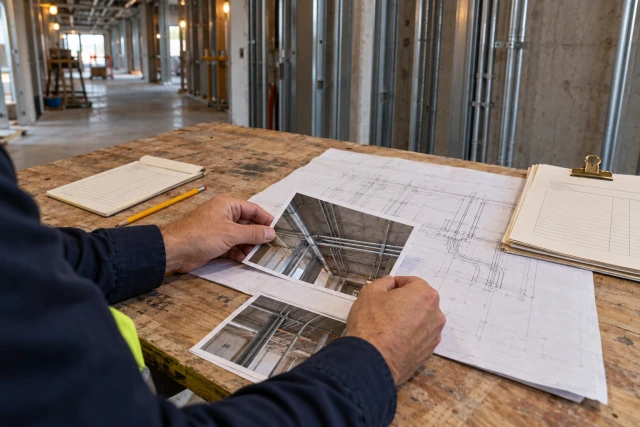
An earthwork quantity-change packet should identify the contract item, comparison scope, measurement basis, source versions and calculation behind the reported difference. Confirm that the quantities cover the same area and represent comparable material states before applying a pricing scenario. Preserve exclusions, technical questions and the actual commercial decision separately. A volume difference does not automatically establish additional payment, an approved change or a valid conversion between bank, loose and compacted material.
What to take away
- Compare the same location, work scope, units and material-state basis.
- Preserve the original survey, model, ticket or calculation sources and their versions.
- Show exclusions and duplicate scope before calculating the difference.
- Separate quantity review, pricing and commercial authorization.
Define which quantity question the packet must answer
Start with the project, contract item, work area and decision being requested. A comparison of current quantities with an estimate differs from a request to change a measurement method or review a new work scope. Identify the actual question before collecting more tickets or exporting another model summary.
Preserve the baseline source and its purpose. It may be an estimate, bid quantity, agreed comparison or earlier reviewed record. Those are not interchangeable. A difference from an estimating assumption should not be labeled an approved change merely because the comparison produces a clear number.
Ask the responsible commercial reviewer to identify the relevant agreement and pricing process. Keep that source beside the quantity question. The packet can help explain what changed and how the figure was prepared without deciding whether normal quantity variation, additional scope or another commercial treatment applies.
Confirm the applicable measurement basis
Identify the required units, work boundaries, material-state basis and method used by the relevant source. A truck count, weigh record, model volume and measured excavation quantity can describe related work without representing equivalent quantities. Record the basis before placing the figures in one comparison column.
Caltrans Construction Manual Section 3-9, published March 2024, directs its project staff to the applicable measurement and payment clauses and describes source documents and audit trails. Its source-document discussion includes item and location references, calculations, preparer and independent checking. These are bounded agency examples, not a universal private-contract measurement or payment rule.
For your project, have the designated technical and commercial sources confirm the comparison basis. A coordinator should not replace a specified method with a convenient model export or choose a conversion factor to make the figures agree. Preserve an unresolved measurement question as a question until the appropriate source resolves it.
Sources: Caltrans Construction Manual Section 3-9, March 2024: measurement, source documents and audit trail
Match the work boundary before comparing totals
Identify the exact area, segment, station range or other location reference used by each source. Record whether it covers the whole item, a progress interval or a defined subset. A later report may include an adjacent work area that the original baseline did not cover.
Keep exclusions visible with their source and reason. Removing an outside area from a comparison is not automatically a contractual credit or a finding that the work is unpaid. It is a scope adjustment for the stated analysis. The reviewer still needs the actual agreement and work records to determine commercial treatment.
Check overlaps before combining several source reports. Two model summaries may include the same area, or a cumulative quantity may already include a prior period’s work. Preserve each source’s coverage and date basis so the comparison does not count the same work twice or mistake a cumulative total for a new increment.
Preserve original models, field records and calculations
Give each source a stable reference, version, preparation date and responsible organization. Link the source to the quantity line it supports. If the number comes from a model comparison, preserve the relevant surface or calculation references as required by the technical process rather than retaining only a screenshot of the final total.
Label source types accurately. A foreman’s reported quantity, a survey-derived calculation and a scale record have different bases and purposes. Each can be useful while leaving a question open. Do not summarize them all as verified actual quantity merely because they are included in the same project folder.
Keep the original record and identify any derived spreadsheet or summary separately. If a preparer corrects a source, preserve the reason and relationship to the earlier version. Another reviewer should be able to follow the current figure back to its source without relying on an undocumented edit inside the commercial worksheet.
Keep material states and conversions explicit
Bank, loose and compacted quantities describe different material-state bases. Record which basis the actual source uses and what the contract comparison requires. A shared label of cubic yards does not by itself make two figures comparable when their underlying states differ.
Where a conversion is needed, retain its actual technical source, scope, assumptions and designated review. This guide does not provide a shrinkage or swell factor. Do not adopt a generic coefficient or calculate a hidden conversion merely to fill a missing worksheet cell; route that question to the responsible technical source.
Keep transport records separate from the defined measurement calculation unless the actual process establishes their relationship. Tickets can help explain activity and source completeness while still leaving a volume-basis question unresolved. A clean comparison should show that limitation instead of treating every recorded load as a measured in-place quantity.
Worked example: remove outside scope before calculating the difference
All quantities, references and rates here are fictional. Assume the technical source has established a common bank-cubic-yard basis for this teaching comparison. The baseline for area A is 1,200 cubic yards. A current report shows 1,480 cubic yards, but 80 belong to area B, which is outside the baseline’s comparison boundary.
Removing those 80 leaves 1,400 cubic yards for the comparable area A scope. The difference from the 1,200 baseline is therefore 200 cubic yards, about 16.7 percent of the baseline after rounding. The unadjusted 280-cubic-yard difference would mix two boundaries and overstate this particular comparison.
For a separate conditional price illustration, assume a reviewed teaching scenario applies an invented $28 per comparable cubic yard to the 200-unit difference. That gives $5,600. The scenario does not establish entitlement, an allowable rate, accepted quantities or an approved change. It isolates scope alignment and arithmetic before any real commercial determination.
| Line | Fictional basis | Quantity or scenario result |
|---|---|---|
| Baseline | Area A / bank cubic yards | 1,200 cubic yards |
| Current source report | Areas A and B / same assumed basis | 1,480 cubic yards |
| Outside comparison boundary | Area B / source-identified exclusion | 80 cubic yards |
| Comparable current scope | 1,480 − 80 / area A | 1,400 cubic yards |
| Comparable difference | 1,400 − 1,200 | 200 cubic yards |
| Baseline-relative difference | 200 ÷ 1,200 × 100 | Approximately 16.7% |
| Conditional price illustration | 200 × invented $28 | $5,600.00 |
Explain the reported change without inventing a cause
Link the quantity difference to the source account of changed information or work. It might relate to a revised design, an altered boundary, a corrected baseline or another reported condition. Identify what the records support and what remains an explanation awaiting review.
A difference between two model totals does not by itself prove a particular site condition or changed-scope entitlement. Preserve the issuing reference, field account and technical assessment where relevant. The coordinator should not convert a numerical difference into a confident causal narrative simply because the commercial packet needs a short summary.
Keep competing explanations visible with their sources. If one report attributes the difference to a revised design while another points to an expanded boundary, ask the responsible technical source to reconcile the comparison. A bounded question about the affected area or source version is more useful than a broad assertion that the quantities must be wrong.
Keep quantity review and price review separate
Identify the actual pricing method and relevant rate source before preparing a proposed amount. A unit-price item, agreed change and another commercial arrangement can require different treatment. An increase in quantity does not necessarily require a new rate or constitute a separate change order under every agreement.
Show the reviewed quantity basis, proposed rate, credits and exclusions clearly. If a rate applies to a different material state or scope, preserve that question instead of multiplying it by the current comparison quantity. A mathematically correct product can still use a commercial basis that the actual project has not accepted.
Label estimates, proposals and agreements distinctly. The $5,600 example is a conditional teaching calculation with no actual approval or billing status. On a real project, retain the designated reviewer’s source for the quantity and pricing decisions before treating a prepared worksheet as an agreed amount.
Ask another reviewer to reproduce the comparison
Give the reviewer the baseline, current source, boundary explanation and calculation. They should be able to identify the common scope and measurement basis, reproduce the exclusion and explain the final difference. If the comparison requires undocumented verbal instructions, improve the index and source references before circulating it.
Check whether the dates and source versions are consistent with the question being answered. A current surface compared with the wrong baseline revision can produce a plausible but irrelevant number. Route the version mismatch to the technical source rather than changing the commercial total to match an expected amount.
Record which part of the packet was reviewed. An arithmetic check, technical quantity review and commercial decision are separate outcomes. Preserve the reviewer, scope and source for each so a successful addition check is not presented as professional verification of the underlying earthwork quantity.
Submit a versioned packet with its open questions
Prepare a short cover identifying the requested decision, comparison scope, quantity difference, conditional pricing and unresolved questions. Link the relevant source index. A recipient should be able to understand what the team is asking without first opening every model, field note and invoice in an unsorted archive.
Retain the transmittal, receiving event and response against the exact packet revision. If the reviewer requests a boundary clarification, assign that action to its source. If the disagreement concerns commercial treatment, route it to the responsible contract or commercial owner instead of repeatedly asking the survey source to defend a pricing decision.
Preserve any revised source and explain the resulting change to the comparison. Keep earlier submissions available with their status. The final approved or disputed amount should remain traceable to the actual decision and should not overwrite the quantity history or appear as paid before accounting records that event.
Download the blank quantity-change evidence register
The free CSV includes the item and decision reference, baseline source, current source, work boundary, units and material state, technical-source metadata, exclusions, comparable difference, proposed pricing basis, reviewer outcomes and next action. It is an evidence index, not a survey calculation tool, conversion standard or payment application.
Enter the 1,200 baseline and 1,480 current report, then identify the 80 outside area B. Confirm that the comparable quantity becomes 1,400 and the difference becomes 200. Keep the conditional $28 rate separate from the quantity review so the numerical result does not acquire an unsupported commercial status.
Pilot one item with the coordinator, technical source and commercial reviewer. Agree where original records live and which process controls measurement and pricing. Resolve scope, unit and version ambiguities before importing several project models or enabling automated reminders across many quantity questions.
Show the missing quantity-source handoff in Buildalytic
Buildalytic advertises custom workflows for requests, logged follow-up, waits and named approvals. Bring a redacted quantity comparison with one unresolved boundary, source-version or pricing-input question. Ask a demonstration to show the precise request reaching the responsible contact and returning to the item and project reference.
Use different paths for a missing source, a technical-review wait and a commercial pricing question. Confirm supported document connections and the reviewer responsible for each decision. The workflow should preserve the evidence without generating certified volumes, selecting conversion factors or approving additional payment on its own.
The practical test is whether another teammate can trace the baseline, current scope, exclusion, proposed difference and next decision. The fictional calculation does not establish a recoverable amount or a measured Buildalytic customer result. Production follow-up should reflect the actual agreement and designated technical and commercial review.
Common questions
Does a higher earthwork quantity automatically create a change order?
Use the actual agreement and pricing process. A difference from a baseline does not by itself determine entitlement or commercial treatment.
Can truck counts be compared directly with bank cubic yards?
Establish the actual measurement and material-state basis first. Do not assume equivalence or apply an unsupported conversion factor.
Why is the example difference 200 rather than 280?
The current report includes 80 cubic yards outside the baseline boundary. Removing that separate area leaves 1,400 comparable cubic yards against a 1,200 baseline.
Sources and editorial notes
- Caltrans Construction Manual Section 3-9, March 2024: measurement, source documents and audit trail
- Buildalytic custom construction workflows
Prepared with AI assistance. Reference date: 2026-10-29. Worked examples are illustrative and are not customer results. Product details can change; confirm the current scope and terms before rollout.
How we prepare and update field notesBring the missing source behind an earthwork quantity question
Bring a redacted baseline, current record and one unresolved boundary or pricing-input question. We will map the source request, designated review and commercial handoff using your process and supported connections.
Start with the call, text or record your team already handles. Review the expected outcome and the human handoff before choosing a rollout.
Request a quantity-record follow-up demo Explore the relevant capability