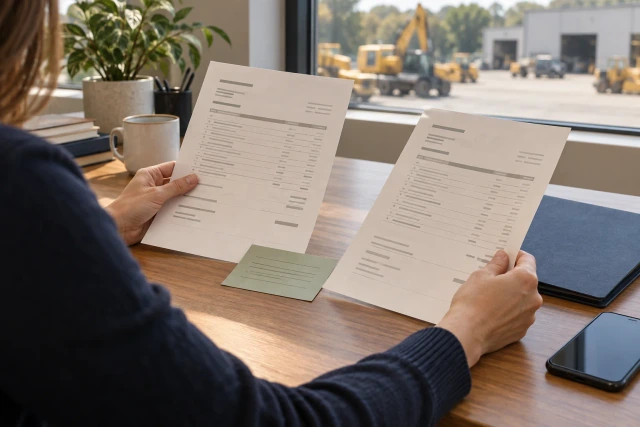
An off-rent confirmation record should identify the rental agreement, exact equipment, project, request time, vendor reference and the scope of the vendor’s response. Track the requested end date, any confirmed rental treatment, physical pickup and later invoice review separately. A crew saying the equipment is finished or a coordinator sending a message does not establish that the vendor received the request or agreed to stop charges. Use the actual agreement and keep the evidence for each step.
What to take away
- Match the request to the actual agreement, unit and pickup location.
- Preserve the vendor’s reference and exact response instead of using a generic confirmed checkbox.
- Keep billing treatment, collection and condition records separate.
- Reconcile the invoice using the actual request and response sources.
Identify the equipment before requesting the change
Record the vendor, branch, rental agreement, project and exact unit reference. Include accessories or attachments where the actual rental record requires them. Two similar lifts on one project can have different agreements and pickup arrangements, so a request saying collect the lift may leave the vendor unable to identify the intended equipment.
Compare the field reference with the rental or delivery record. If a unit was exchanged, preserve the relationship and identify which unit is now being collected. Do not close the original reference and assume the replacement inherited every administrative event. Keep each actual unit and request traceable.
Assign the internal request owner and the field contact who can clarify location and readiness. The equipment coordinator may manage the vendor account while the superintendent knows the current access arrangements. A clear division of responsibilities lets the request move without asking one person to certify facts they have not observed.
Check the actual return and off-rent process
Locate the applicable rental agreement and current vendor instructions for the action being requested. Identify the authorized request channel, required references and actual recipient. A contact message to a salesperson may help coordinate the work while still differing from the agreement’s required process.
Sunbelt’s published US return terms provide a specific example: they describe obtaining a pickup number, condition-related responsibilities and conditional treatment of rental charges after that reference is given. This is a vendor-specific example, not a promise that every rental ends financially or physically when someone calls. Confirm the actual agreement and preserve the response.
Record any unresolved requirement or commercial question for the responsible reviewer. Do not choose a date that produces the lowest invoice and label it confirmed without a source. The coordinator can prepare an accurate request and follow-up record while leaving contested rental treatment to the appropriate vendor and commercial process.
Sources: Sunbelt Rentals US terms: return of equipment and pickup references
Confirm the field’s actual readiness account
Ask the responsible field contact which unit is finished, where it is located and what the pickup source needs to know. Preserve that account and its date. A crew’s anticipated finish date should remain a plan until the relevant source confirms the current position.
Use the project and vendor procedures for access, condition and collection preparation. The administrative template should reference those requirements rather than provide operating or loading instructions. If the equipment is still needed by another crew, resolve that project question before a coordinator sends an instruction that conflicts with the field plan.
Keep readiness separate from the vendor acknowledgment. The project may be ready while the vendor has not received the request, or the vendor may have a request while access remains unclear. These are different action paths. A single off-rented status can hide the exact missing step that is causing repeated calls.
Use request wording that asks for the right confirmation
Adapt this request to the actual agreement and channel: Please record our pickup/off-rent request for [agreement], unit [identifier], at [project and location]. Our field contact reports it ready from [date and time basis]. Please confirm receipt, your request reference, the recorded rental treatment and the proposed collection arrangement. Our contact for access questions is [authorized contact].
Add the actual source references and any relevant scope limitation before sending. If the message requests only collection, do not imply that a billing outcome has already been agreed. If another notice or process is required, use the responsible reviewer’s instructions rather than assuming this sample wording satisfies every contractual requirement.
Retain the sent version and channel. When a vendor replies, preserve its wording and identify which questions it answers. Received is not necessarily a confirmed end date; pickup scheduled is not completed collection. A useful response record lets another coordinator understand the actual position without having to reconstruct the phone conversation.
Worked example: one unit, four evidence stages
The unit, dates and references below are fictional. Cedar’s field contact reports unit E-77 ready on November 16, 2026, at 09:00 using the project’s stated local time basis. The coordinator sends request O-71 at 09:20. At 10:05, the vendor provides a request reference and a response that is retained in the record.
The vendor’s response proposes collection on November 18. The example has no physical pickup record yet and does not establish the rental-charge treatment beyond what the actual response says. The coordinator keeps the proposed date separate from the request date and assigns the remaining collection and billing questions.
The timeline does not turn a planned pickup into a completed return or infer a free rental period. It shows what source exists at each stage. The next person should be able to identify the field account, sent request, vendor response and open action without interpreting four different dates as one off-rent event.
| Stage | Fictional source | Current position |
|---|---|---|
| Field readiness | November 16 / 09:00 / field account | E-77 reported ready |
| Request sent | November 16 / 09:20 / O-71 | Sent record retained |
| Vendor response | November 16 / 10:05 / request reference | Exact response and proposed November 18 collection retained |
| Physical collection | No pickup record yet | Collection confirmation outstanding |
Capture the vendor reference and its actual scope
Record the vendor request or pickup number, source contact, time and relevant response details. Check that the reference concerns the correct agreement and unit. A reference for another machine or an earlier request can make a later invoice comparison misleading even when the coordinator has a valid-looking number.
Separate confirmed details from unresolved ones. The vendor might acknowledge receipt and identify a collection window while leaving a billing question for another contact. Record those distinct outcomes and route the remaining question. Avoid repeatedly asking for general confirmation when the missing issue is specifically the rental-charge basis.
If a response changes, preserve the earlier version and the current source. A revised pickup window may explain why the equipment remains on site without changing every other agreement term. Keep the history so the project and accounting teams can understand which part of the arrangement changed and who stated it.
Coordinate collection access without closing the request prematurely
Give the relevant vendor contact the authorized location and access information required for collection. Preserve the source of those details and any change. A gate or contact mismatch can prevent pickup even when both sides believe an appointment exists, so the coordinator should make the receiving arrangement clear.
Keep failed collection, rescheduling and completed collection as separate events. Record what the responsible source reports and any requested next action. Do not assume every missed pickup is the vendor’s fault or that an unattended unit necessarily satisfied the required preparation and access process.
Route operational and condition questions to the responsible field and vendor contacts. The record can track the action and outcome without instructing people to load, move or operate equipment outside the actual procedures. Administrative closure should wait for the evidence required by the defined collection task.
Preserve physical pickup and return-condition records
When collection occurs, retain the actual pickup source, unit reference, date and relevant handoff record. Distinguish a scheduled truck arrival from the reported collection of the equipment. If the vendor collects several units, confirm which references are covered rather than marking every open rental returned.
Keep condition observations and any later vendor assessment connected to the unit. A completed pickup record and a condition question can coexist. Do not rewrite the collection date to conceal an unresolved issue or present the collection acknowledgment as an agreement about every possible damage or final charge.
If the field and vendor accounts differ, preserve both with attribution and ask a bounded question. The coordinator should not decide responsibility merely to close the rental queue. The useful record identifies what was collected, which source says so and what still requires another designated review.
Use the timeline to review the invoice
Connect the next invoice or final charge to the actual agreement, request and vendor response. Identify the billed period and the precise line being questioned. The accounting owner should compare the charge with the applicable source, rather than calculating a credit from the crew’s anticipated finish date alone.
If a discrepancy is identified, preserve the original invoice and submit the question through the actual process. Ask for the relevant rental-treatment explanation or adjustment reference. Keep a requested credit, vendor-stated adjustment, issued memo and applied amount as separate states so the timeline remains useful after collection.
Do not erase the original charge when an adjustment is discussed. Accounting needs the source history to reconcile the outcome to the correct project and unit. An off-rent coordination record can support that review without determining entitlement, issuing a vendor credit or directing payment treatment.
Handle partial returns and changed plans explicitly
A project may finish with one attachment while retaining the main unit, or send one machine back while another remains. Record the exact scope of each request and the vendor’s response. A partial return should not automatically close every item on the agreement or remove a continuing need from the field plan.
If the project changes its mind after requesting collection, preserve the cancellation or revised request through the actual vendor process. Keep the original acknowledgment and the new response linked. A field message that the unit is needed again should not silently erase a collection arrangement already communicated to the vendor.
Review recurring exceptions with the equipment and accounting owners. Missing unit numbers, unclear access contacts and responses without a billing reference can be corrected at intake. More reminder calls are not proof of a successful return; use the actual receiving and reconciliation evidence to identify what remains open.
Download the blank off-rent confirmation register
The free CSV includes the agreement and unit, project location, readiness source, request time and channel, vendor reference, confirmed response scope, collection plan, actual pickup, condition question, invoice reference and next action. It is a coordination record, not a rental cancellation agreement or a statement that charges have stopped.
Enter O-71 and keep the November 16 request separate from the proposed November 18 collection. Test a vendor response that confirms receipt but leaves rental treatment unresolved. The worksheet should preserve that partial response and route the billing question instead of turning any acknowledgment into full closure.
Pilot one unit with the field contact, equipment coordinator and accounting owner. Agree which sources establish readiness, collection and invoice treatment. Resolve ambiguous status labels before importing a large rental list or enabling repeated automated requests across several vendors and project accounts.
Bring the missing off-rent acknowledgment to Buildalytic
Buildalytic advertises custom workflows for requests, logged follow-up, waits and named approvals. Bring a redacted rental reference with one unanswered pickup or billing-treatment question. Ask a demonstration to show the precise request reaching the vendor contact and the reply returning to the unit and project record.
Test missing receipt confirmation, a rescheduled collection and a later invoice question as separate paths. Confirm supported systems, permissions and the person responsible for the next review. The workflow should preserve the vendor’s response without promising a charge cutoff, completed return or recovered credit on its own.
The practical test is whether another coordinator can trace the readiness account, sent request, vendor reference, physical pickup and invoice question. The fictional timeline does not establish a real rental outcome or measured Buildalytic customer result. Production follow-up should reflect the actual agreement and authorized field and commercial process.
Common questions
Does sending an off-rent request stop charges?
Use the actual agreement and vendor response. The sent request is one event; confirmed rental treatment and physical collection need their own source records.
What should the confirmation include?
Identify the agreement, unit, vendor reference, response time and exact scope confirmed. Keep a proposed pickup, billing position and unresolved question distinguishable.
Is the download a vendor cancellation form?
No. It is a blank request-and-response register. Use the actual required channel and process for the rental involved.
Sources and editorial notes
- Sunbelt Rentals US terms: return of equipment and pickup references
- Buildalytic custom construction workflows
Prepared with AI assistance. Reference date: 2026-10-29. Worked examples are illustrative and are not customer results. Product details can change; confirm the current scope and terms before rollout.
How we prepare and update field notesBring the pickup request that still needs an answer
Bring a redacted agreement and unit reference with one missing vendor acknowledgment or invoice question. We will map the request, response and named handoff using your process and supported connections.
Start with the call, text or record your team already handles. Review the expected outcome and the human handoff before choosing a rollout.
Request an off-rent follow-up demo Explore the relevant capability