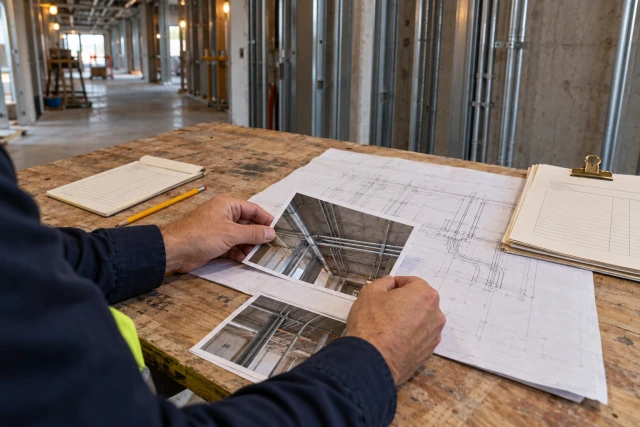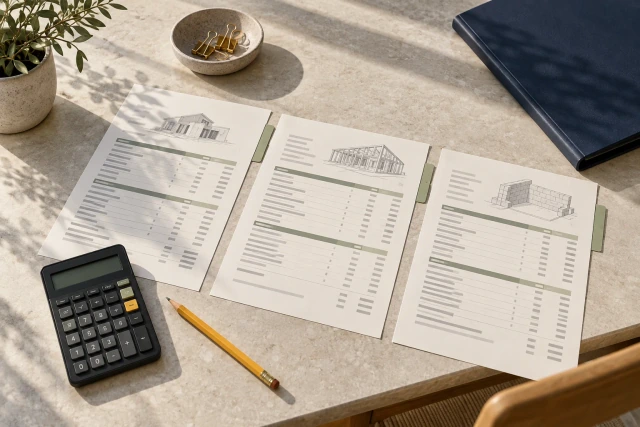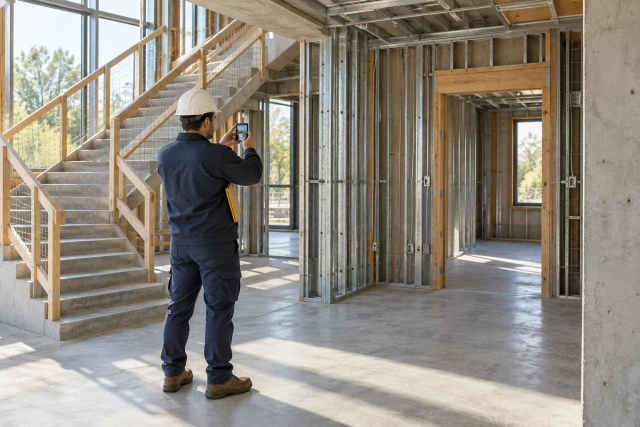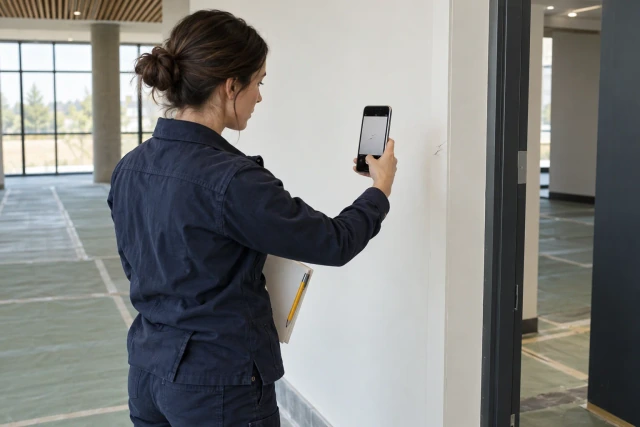
A useful backcharge record separates the observed condition, alleged responsibility, actual contract process, communications, work performed and proposed cost. Preserve original evidence, identify unanswered scope or notice questions, and route the commercial decision to the authorized reviewer. A photo of damage or a correctly added cost table does not by itself establish liability or a right to deduct payment. The packet should let another person follow the facts and open questions without relying on an accusation in an email subject.
What to take away
- Describe the observed condition without treating an allegation as a finding.
- Use the actual agreement to identify the required notice, response and decision process.
- Connect each proposed cost to the relevant work and supporting source.
- Keep a proposed backcharge separate from an approved deduction or actual accounting entry.
Identify the actual decision being requested
Begin with the project, location, affected work and the party’s stated concern. Is the team asking for inspection of a condition, correction of work, cost review, reimbursement or treatment of a payment? These questions can share an event reference while requiring different evidence and different authorized recipients.
Preserve the original communication and distinguish its allegation from the coordinator’s factual account. A subject line saying subcontractor damage is not independent evidence of who caused the condition. The record should make clear what was observed, what another person reported and what remains to be established.
Use a stable event ID across the photo record, correspondence, work documentation and cost worksheet. Keep it distinct from a later formal backcharge or payment reference. This lets the team assemble a coherent packet without pretending that the existence of an internal event number means the commercial request has been accepted.
Find the relevant contract and review process
Ask the responsible contract administrator to identify the applicable agreement, scope provisions and process for the action under consideration. Record the actual source and designated reviewer. A generic backcharge template should not be treated as proof that every notice, response opportunity or payment step required on this project has occurred.
Identify which communications are required, who sends them, the proper recipient and any actual timing basis. Keep proposed notices waiting for the necessary review. This article does not prescribe a universal cure period, deduction right or markup; those questions depend on the actual arrangement and authorized commercial assessment.
If several processes may apply, preserve their relationship. A manufacturer warranty request, a subcontract correction issue and a damage allegation can require different paths. Do not collapse them into one backcharge category merely because each may involve a cost. The correct route determines which source and decision the packet actually needs.
Capture the condition and its observation limits
Record what the observer actually saw, where, when and from what position. Preserve original photos and a stable location reference. A concise description of the visible scuff, missing component or unfinished activity is more useful than a broad statement that a trade ruined an area.
Separate the photographer, uploader and person describing the event when they differ. If the condition was reported after the fact, retain the actual reporting time rather than presenting it as a direct observation from the earlier shift. Uncertain dates, locations or identifiers should remain questions until clarified by a relevant source.
Keep immediate technical or safety reporting within the project’s actual procedures. A document packet should reference the responsible notification without delaying a required response or inventing corrective instructions. The administrative record can support review while leaving technical assessment and work authorization with the people responsible for them.
Build a chronology that preserves missing evidence
List the relevant baseline record, first observation, notification, response, access arrangements, work direction, reported corrective activity and later review. Use source references beside the events. If a date or communication is missing, show that gap instead of filling it with a plausible sequence inferred from the final repair invoice.
Compare before and after records carefully. A prior photo may show a different angle or an earlier stage, and an after photo may show a finished repair without explaining the original cause. State what each image can support and where another source is needed. Do not turn a gap between photos into proof that a particular crew caused the condition.
Preserve differing accounts with attribution. One trade may report that an area was handed over undamaged while another describes damage on arrival. Ask for the actual location, time and supporting record from each source. The chronology should help the authorized reviewer assess the disagreement rather than erase it into one confident narrative.
Track the actual request and response
For each communication, record the sender, recipient, scope, channel, time and source. Distinguish a request to inspect from a direction to perform work or a proposal to recover cost. A reply saying received may answer the receiving question without resolving responsibility, scope or commercial acceptance.
If a response offers to inspect, identifies a different party or disputes the allegation, preserve that position and assign the next action. Do not summarize every response as refusal to correct. Likewise, no response should remain no response unless the actual governing process and responsible review establish another consequence.
Track access or coordination issues explicitly. A party might be willing to review the condition but lack access at the proposed time. Route that operational question to the project coordinator while preserving any separate commercial issue. Accurate status labels prevent reminders from accusing the wrong person of ignoring a task they could not complete.
Connect reported corrective work to its actual basis
Identify who performed the work, what was done, when and under which actual instruction or approval reference. Retain the source scope and relevant daily records. A contractor’s invoice can document a proposed charge while still leaving questions about whether the activity concerned this condition or included other work.
Check the receiving process before assuming one form applies to every request. CornellCookson’s public labor-reimbursement page, for example, describes a manufacturer-specific warranty process and asks for itemized costs, an invoice and supporting documentation. It is not a generic subcontract backcharge entitlement or a universal schedule of allowable rates.
For your packet, identify the actual work and reimbursement process instead of copying that manufacturer’s terms. Preserve any requested advance review, approved scope and resulting completion record from the applicable source. A clean evidence index should make the limits of the record visible without implying that documenting work automatically establishes who must pay for it.
Sources: CornellCookson: manufacturer-specific labor cost reimbursement form and evidence requests
Worked example: a proposed $660 packet with an open responsibility question
The project, event and amounts here are fictional. Event B-31 concerns a scuffed wall area. The coordinator has a location photo, correspondence, a reported six-hour corrective task and associated material and equipment records. The responsibility question remains open and is assigned to the designated commercial reviewer.
For arithmetic only, assume six hours at an invented $80 rate, $160 of materials and $60 of equipment. The gross proposed cost is $700. An assumed confirmed $40 material credit reduces the example’s net proposed amount to $660. No markup, tax or other amount is included in this limited teaching scenario.
The table checks addition and source relationships, not allowability. The reviewer still needs to assess the actual work scope, cost basis, credit, contract process and responsibility evidence. A six-hour record does not prove that six hours are recoverable, and a net total does not authorize an accounting deduction.
| Line | Fictional arithmetic / basis | Proposed amount |
|---|---|---|
| Labor | 6 hours × $80 | $480.00 |
| Materials | Example supported source amount | $160.00 |
| Equipment | Example supported source amount | $60.00 |
| Gross proposed cost | $480 + $160 + $60 | $700.00 |
| Material credit | Assumed confirmed source | −$40.00 |
| Net proposed amount | $700 − $40 | $660.00 |
Check scope overlap, credits and estimated amounts
Give every proposed cost line a reference to the activity and supporting record. Identify whether the amount is estimated, quoted, invoiced or otherwise documented. Preserve that label through the packet so an early estimate does not become an asserted actual expenditure merely because someone copied the figure into a formal-looking PDF.
Check for overlapping labor, ordinary contract work or duplicated attachments. A daily time record may include work outside the corrective activity. An equipment invoice may cover a longer period. Ask the source to explain the relevant allocation rather than charging the whole document total to the event without a basis.
Keep credits and revised amounts visible. If the source later confirms a different material credit, preserve the prior submission and explain the revised total. Do not hide a negotiated reduction by editing the original cost record. A reviewer should be able to distinguish a changed source amount from a commercial adjustment agreed during review.
Give the other party a readable evidence packet
Organize the submission around the actual question and process: event summary, scope, chronology, communications, work record, cost worksheet and unresolved issues. Use an index with stable file references. Attaching a large folder without explaining which document supports which statement makes a meaningful response harder to prepare.
Preserve the recipient’s actual position beside the affected issue. A disagreement about causation differs from a request for a missing receipt or a challenge to the labor allocation. Route those questions to the appropriate source instead of repeatedly sending the same total with a more urgent subject line.
Keep the response and any revised packet connected to the original event. Do not remove contradictory evidence or summarize a partial agreement as acceptance of the entire amount. The commercial reviewer needs to see both the current proposal and the actual remaining disagreement to make a supported decision.
Record the commercial outcome before the accounting handoff
Identify the authorized outcome, scope, amount and source when a decision is made. The packet may remain disputed, be withdrawn, be revised or reach an agreed treatment. Use the actual result rather than assuming every completed document-collection task ends in an approved backcharge.
Give accounting the designated source for any approved treatment and the related project and payment references. Preparing a proposed amount is not the same as posting a deduction. Keep the actual accounting entry, subsequent credit and payment reconciliation distinct from the earlier proposal and supporting evidence.
If the matter remains open, preserve the next action and owner. The workflow can still be functioning when it exposes a decision awaiting the proper reviewer. Do not close an unresolved commercial issue solely to improve a completion metric or erase its earlier history after an unrelated payment is processed.
Use the blank backcharge evidence register
The CSV includes the event and location, observation source, alleged responsibility, actual contract-process reference, communication history, corrective-work source, cost basis, credit, proposed amount, response, designated decision and accounting handoff. It is an administrative index, not a notice form, liability finding or instruction to deduct payment.
Enter B-31 and reproduce the $660 example. Keep the responsibility question open while the arithmetic check is complete. Then test a missing work-direction reference and a response disputing the labor allocation. The register should assign those actions separately rather than convert a completed calculation into an approved commercial result.
Pilot one redacted event with the project manager and commercial reviewer. Agree who can send formal communications and who controls any accounting treatment. Check that the intended recipient can open the evidence links before adding automation to a portfolio of unresolved issues.
Demonstrate the missing-evidence request with Buildalytic
Buildalytic advertises custom workflows for requests, logged follow-up, waits and named approvals. Bring a redacted event with one missing record or unanswered scope question. Ask a demonstration to show the specific request reaching the responsible source and returning to the original event reference.
Test a missing photo context, a cost-allocation clarification and a commercial question as different paths. Confirm supported systems, access controls and the actual reviewer who owns the decision. The workflow should preserve the evidence and response without deciding fault, authorizing corrective work or posting deductions on its own.
The practical demonstration is whether another person can follow the condition, chronology, proposed cost and unresolved decision. This guide’s fictional packet does not establish recoverability or a measured Buildalytic customer outcome. Production follow-up should reflect the actual contract process and authorized commercial review.
Common questions
Does a damage photo prove who should pay?
A photo can support a condition record within its actual context. Responsibility and commercial treatment require their own evidence and authorized review.
Is there a standard backcharge notice period?
This guide prescribes none. Identify the actual agreement, required communications and responsible reviewer for the action being considered.
Can accounting deduct the proposed $660?
The invented example verifies arithmetic only. Any real accounting treatment needs its actual authorization, source amount and applicable process.
Sources and editorial notes
- CornellCookson: manufacturer-specific labor cost reimbursement form and evidence requests
- Buildalytic custom construction workflows
Prepared with AI assistance. Reference date: 2026-10-29. Worked examples are illustrative and are not customer results. Product details can change; confirm the current scope and terms before rollout.
How we prepare and update field notesBring the unanswered evidence question in your backcharge packet
Bring a redacted event, the actual process reference and one missing record. We will map the source request, response and named reviewer using your workflow and supported connections.
Start with the call, text or record your team already handles. Review the expected outcome and the human handoff before choosing a rollout.
Request an evidence follow-up demo Explore the relevant capability