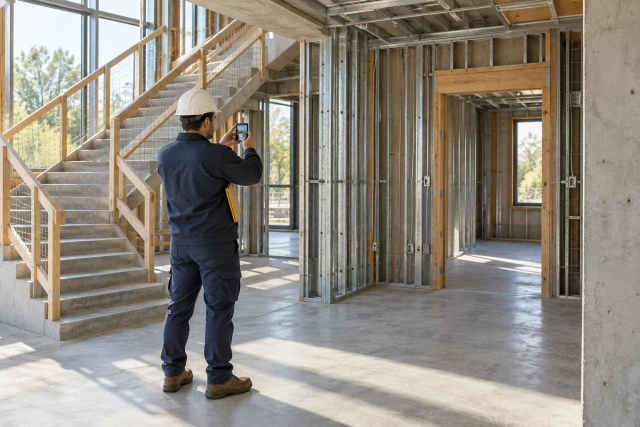
A pre-cover coordination checklist should identify the exact work and location, applicable inspection or hold-point source, responsible trade, required evidence, actual inspection record, open corrections and the person authorized to determine the next step. Keep readiness reports, photos, scheduling and recorded approval separate. Use the current project and jurisdiction requirements; a complete photo folder is not permission to cover work.
What to take away
- Define the location and work scope before collecting photos or requesting an inspection.
- Track the required authority decision separately from contractor readiness reports.
- Link every correction and later inspection to the original hold point.
- Keep the next operation tied to its actual required approvals and project controls.
Use the checklist to coordinate the hold point
Before work disappears behind a finish, backfill or another operation, the team needs to know what records and decisions the actual process requires. Start with the particular area and planned next operation. A broad note such as inspect second floor can hide several work scopes with different responsible people.
The checklist is an administrative coordination record. Its job is to connect the current location, source requirement, readiness statement, evidence, inspection event and unresolved action. It should help the superintendent see the next responsible person without pretending to supply a technical inspection method.
Keep the actual site controls in force while questions are unresolved. If someone cannot identify the applicable hold or decision owner, route that question to the responsible project team before treating a planned date as authorization. A calendar entry and an uploaded photo answer different questions from an inspection result.
Identify the requirements for this location and scope
Collect the relevant approved plans, permit conditions, inspection instructions, project inspection or test plan and applicable contractual hold points. Record the source version and the person who confirms applicability. Requirements can differ across jurisdictions, disciplines, assemblies and project specifications.
Portland’s current residential inspection guide provides a specific local example: permitted work must be inspected before concealment, approved plans must be available and a consultation is distinct from an approved inspection. Those statements explain why coordination matters; they are not a universal sequence or technical checklist for every project.
Ask the actual authority or designated professional about unclear scope. Keep permit inspections, special inspections, testing and internal quality review distinguishable where the project requires them. One completed event should not clear another required process merely because both concern the same room or work package.
Sources: Portland Permitting & Development: Residential Inspections, Start-to-Finish Guide
Make the work retrievable before photographing it
Give the hold point a stable ID and a location meaningful to the field team: building, level, room, grid or another accepted project reference. Link the relevant drawing and revision. A close-up of a repeated detail can be difficult to place after a crew has moved to the next area.
Describe the work package and intended concealment boundary. If a record covers only one wall or segment, say so. Avoid allowing a general room label to imply that every installation in that room was documented, reviewed or accepted. Ask the responsible owner whether a broad area needs several separate records.
Retain the source for later location corrections. If a trade explains that an image was assigned to the wrong room, link the clarification and correct the current reference without rewriting the original file as though it had always been correctly located. The history helps another reviewer understand the current evidence set.
Collect an item-specific readiness statement
Ask the responsible trade to report the particular work scope, location and readiness basis required by the project. The useful response identifies what is reported complete and any remaining constraint. Ready should not be a default value applied because the scheduled inspection date is approaching.
Keep the reporting person, time basis and source. A foreman’s statement can help coordinate the next review while remaining a contractor statement. It should not be relabeled as an authority inspection or a professional acceptance. If the response mentions an unresolved prerequisite, assign that question rather than hiding it in a note.
Confirm the actual inspection arrangements through the required channel. Track a request, scheduled event, cancellation and completed visit separately. If access or documentation is unresolved, retain the gap and contact the responsible owner. Do not promise an inspection time or infer a completed inspection from a request confirmation.
Assemble contextual evidence without overstating it
Follow the evidence requirements identified by the actual reviewer. For each image, preserve the original file, stable photo reference, project, location, reported work date, capture or upload context and the record it supports. General context can help a reviewer interpret a detail image without guessing where it was taken.
Do not infer hidden conditions, measurements or test results from visual appearance. A photograph may support a review and still leave another required record unresolved. Use the designated reviewer’s request to determine what evidence is missing rather than assuming more photos automatically produce a complete package.
Austin’s Building Inspections page describes uploading supporting records such as photos, surveys and engineering reports for inspection review. That is a bounded example of document support within an authority process. The upload itself is not a replacement for that authority’s inspection or approval.
Sources: Austin Development Services: Building Inspections and supporting attachments
Worked example: four hold points with different evidence gaps
The location IDs and records below are fictional. Cedar has four hold points in its coordination view. H-31 has a trade readiness report and photo references, but the required authority inspection has not occurred. H-32 has an inspection record with a correction still open. H-33 has a linked required decision for its narrowly identified scope.
H-34 has an inspection request but a missing approved-plan reference. At the checkpoint, only H-33 has the recorded decision required by the exercise’s definition. That is one of four records, or 25%, and describes only the administrative roster. It is not a claim that 25% of the building is complete or safe to conceal.
The superintendent follows the actual site and authority controls for each work area. The coordinator obtains H-31’s actual event record, routes H-32’s correction to its owner and resolves H-34’s plan question. None of those actions can be replaced by calling every row photo complete.
| Hold point | Evidence at checkpoint | Open action |
|---|---|---|
| H-31 / room 204 wall A | Trade readiness and contextual photos | Required inspection event / decision pending |
| H-32 / corridor segment B | Inspection record with correction | Responsible trade and reviewer address correction |
| H-33 / room 206 wall C | Required decision linked for stated scope | Retain source; follow actual next-operation controls |
| H-34 / room 208 wall D | Inspection requested; plan reference missing | Designated owner resolves current-plan basis |
Record what actually happened at the inspection
Link the actual event to the hold-point ID, location, scope, date basis, responsible inspecting party and source record. Use the recorded result and its limitations. A visit may cover a particular scope, be incomplete because access was unavailable or result in a correction requiring another step.
Avoid translating every visit into passed. Retain the authority’s or designated reviewer’s actual wording and identify the next action. If a verbal update needs a formal source under the project process, track that outstanding record rather than treating a secondhand summary as the final disposition.
Separate the inspection event from a broader commercial or program milestone. A recorded result for one scope does not establish all-trade completion, payment entitlement or occupancy permission. The coordination record should make its boundary clear enough that another team does not rely on it for a different decision.
Keep the correction and the new evidence connected
When an inspection or review identifies a correction, preserve its source, affected location, responsible trade, required response and review owner. Keep the original hold point open in the way the actual process requires. A new photograph should be linked to the correction it addresses rather than replacing the earlier record without context.
For H-32, the trade can report that the correction is ready for review. That statement is useful, but it does not complete the required reinspection or other designated decision. Record the actual next step and outcome when it occurs. If the scope of the response is unclear, route the question to the responsible reviewer.
If work changes after an earlier review, notify the appropriate project owner and follow the applicable process for the change. Do not assume an older result automatically covers revised work. Preserve the original decision and the changed scope so the person with authority can determine what further action is required.
Make the next-operation decision traceable
The person coordinating the next trade needs the actual status for the affected area and scope. Link the required inspection or approval source and any separate project hold-point decision. Use the project’s real release process and authorized people; do not create a universal release role in a generic worksheet.
H-33’s linked decision applies only to its stated scope in the fictional exercise. Another trade’s unresolved inspection or a different wall may still be subject to its own controls. A summary should preserve those boundaries instead of describing the whole floor as released because one record is complete.
If evidence and authority status conflict, keep the discrepancy visible and ask the responsible owner to resolve it. Do not use an automated green status, the number of photos or a planned crew date to override an unresolved requirement. The record should communicate the question to the person who can decide it.
Preserve evidence after the area changes
Store the original evidence and final review records in the approved project destination with meaningful references. A later user should be able to find the work location, source plan, inspection event, correction history and scope of the recorded decision. A folder labeled before drywall is often too broad for later retrieval.
Record the actual next-operation event when the project process calls for it, without using that timestamp to invent an earlier approval. If someone later asks when the area was covered, the team should distinguish a reported operation date from the date a photograph was uploaded or a review record was received.
Test retrieval with a person who did not create the record. Ask them to locate H-32’s original comment and its current response. If they cannot tell which evidence is current, improve the references and version labels. Preserve original files so later clarifications do not depend entirely on a renamed display copy.
Use the free pre-cover coordination register
The blank CSV includes project, hold-point ID, location and scope, requirement source, plan revision, responsible trade, readiness statement, evidence references, inspection request, actual event, disposition, correction, required decision source and next action. It organizes the record; it is not an inspection certificate or technical acceptance checklist.
Enter H-31 through H-34 and test an updated photo, an inspection cancellation and a correction response. Each update should retain its source and change only the relevant state. A cancellation should not become a completed event, and a photo replacement should not clear an open correction.
Pilot one bounded area with the superintendent, responsible trade and actual review owner. Agree which source is needed before each status can change. Confirm that the person scheduling the next operation can understand the scope and any open hold without reading every message in the project history.
Coordinate missing hold-point records with Buildalytic
Buildalytic’s custom-workflow page describes requests, response logging, waits and named approval steps. Bring a redacted hold-point record with a missing trade response, source document or correction update. Ask how the workflow requests the specific gap and returns the answer to the responsible project owner.
Demonstrate H-31 awaiting an event record, H-32 awaiting correction review and H-34 awaiting its plan reference. Confirm the supported document connections and permissions. A useful workflow should keep those paths separate and show where it waits for the actual inspection or designated decision record.
The demo should make the next action and its source easy to inspect. Buildalytic coordination does not inspect concealed conditions, certify work from photos or grant permission to cover it. The fictional exercise does not claim an avoided rework cost, faster inspection or verified customer outcome.
Common questions
Can photos replace a required pre-cover inspection?
Do not assume they can. Follow the actual authority and project requirements. Photos can support the record without supplying a required inspection or approval.
Is an inspection request enough to move to the next operation?
A request establishes a scheduling action. Track the actual event, result, corrections and required decision under the applicable process separately.
What location detail should the register include?
Use the project’s meaningful location structure and specific work scope, with the current plan reference and evidence links. Avoid a broad label that implies unrelated areas were reviewed.
Sources and editorial notes
- Portland Permitting & Development: Residential Inspections, Start-to-Finish Guide
- Austin Development Services: Building Inspections and supporting attachments
- Buildalytic custom construction workflows
Prepared with AI assistance. Reference date: 2026-10-29. Worked examples are illustrative and are not customer results. Product details can change; confirm the current scope and terms before rollout.
How we prepare and update field notesBring a hold point with a missing record or response
Bring a redacted location record, requirement reference and open action. We will map the evidence request, responsible person and review hold using your project process and supported connections.
Start with the call, text or record your team already handles. Review the expected outcome and the human handoff before choosing a rollout.
Request a field-evidence workflow demo Explore the relevant capability