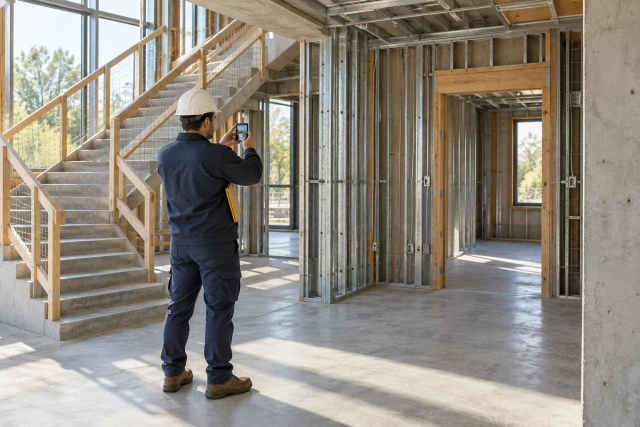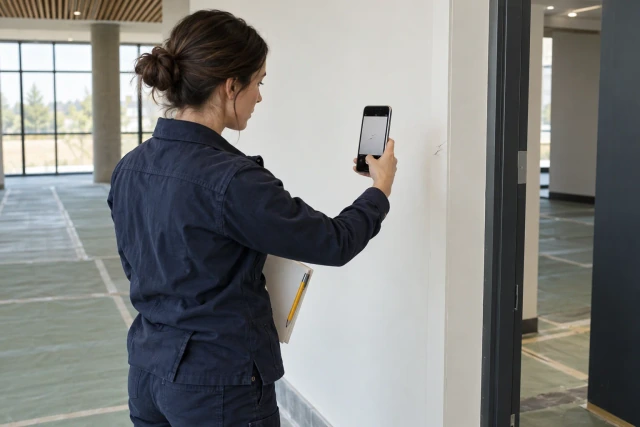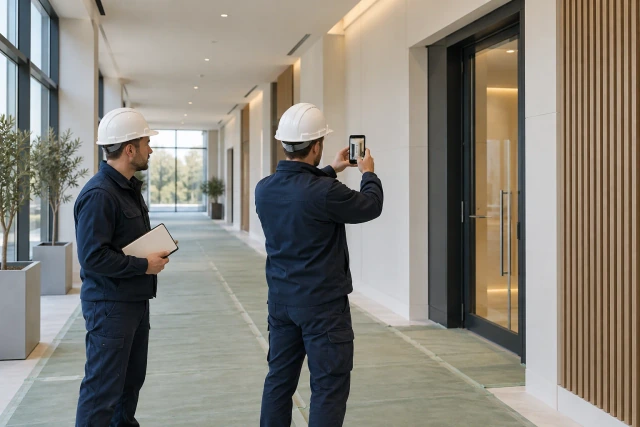
For a damage-by-others concern, document the defined area and observed condition before and after the relevant handoff, preserving original photos, capture context, observer accounts and access limits. Record who reported a concern and what the evidence actually shows. A photo sequence can help explain a condition change while leaving its cause, responsibility and commercial treatment unresolved. Route those decisions through the authorized project process rather than turning a handoff acknowledgment into an admission.
What to take away
- Define the location and coverage before comparing two photo sets.
- Separate capture time, upload time and an observer’s later account.
- Keep unobserved areas and disputed descriptions visible.
- Link condition records to the next review without assigning fault automatically.
Define the handoff area and purpose
Name the project, floor, room, elevation or other useful location boundary. State whether the record concerns a completed finish, protected work, shared access route or another defined item. A folder called corridor handoff is difficult to interpret if the later concern involves a doorway outside the photographed view.
Identify the expected transition and the people recording it. An outgoing foreman can describe the work being handed over, while an incoming contact may identify access or coverage questions. Record each person’s role and account without assuming either has authority to settle responsibility for an undiscovered condition.
Agree the practical purpose of the record before collecting it. It may establish what was observed at a particular time and identify questions needing follow-up. It should not silently become a blanket statement that every surface is flawless or that one trade accepts responsibility for every later change in a shared area.
Record the observed condition before the transition
Capture enough surrounding context to connect a detailed view with the actual location. Identify the surface or component, visible protection and existing concern. Keep the original file and its relationship to any annotated copy so a reader can distinguish the source from later explanation.
Describe only what the observer could see. A wide corridor image may establish the general setting without showing the lower corner of a doorframe. Note that coverage limit instead of treating the absence of a visible mark in the wide image as proof that the corner was undamaged.
Follow the site’s authorized access and work arrangements while recording. If an area cannot be observed, state that limitation and route the next action to the responsible person. The record should preserve a gap honestly; a complete-looking checklist is less useful if it hides the fact that a protected or inaccessible surface was never seen.
Keep capture context separate from the upload event
Preserve the original file, available capture information, photographer and the observer’s account of when the view was taken. Distinguish that context from the date a coordinator uploaded a batch or added it to a daily report. A later filing event does not by itself establish the time of the condition shown.
Procore’s upload instructions illustrate a specific metadata trap: its date field can use capture information, but defaults to the current date when that information is missing. A date displayed after upload therefore needs context before someone relies on it as the actual capture date. This is a vendor-specific behavior, not a claim about every photo system.
If the timing is uncertain, retain the uncertainty and seek clarification from the source. Do not edit a date merely to make the sequence support a preferred account. A later recollection can be retained as a separate attributed statement while the original file and its available metadata remain intact.
Sources: Procore: upload-photo dates, location and permissions
Distinguish direct observation from an attributed report
Use language that identifies the source of each statement. An observer may report seeing a mark during a walkthrough. Another person may say a particular crew caused it. These accounts can be important while answering different questions, and the second does not become a direct observation simply because it is copied into a coordinator’s log.
Preserve the actual wording of a disputed description and connect it to its author or source. If the team later agrees a corrected description, retain the revision relationship. Avoid labeling a row confirmed damage by others when the only established fact is that a concern was reported after another trade entered the area.
Invite a bounded response through the authorized project process. Ask the relevant contact to identify the area, timing or evidence they can clarify. A handoff receipt can acknowledge that a record was received while leaving its content or commercial significance under review. Keep those scopes explicit rather than substituting a generic signed status.
Compare later records using the same location boundary
When a concern is reported, connect it to the earlier location and item reference. Compare the available views and their coverage before describing a change. Similar-looking doorways on the same floor can create a false comparison if the original records were not tied to a stable location identifier.
Identify differences in viewing angle, lighting, protection and visibility that affect interpretation. A later close-up may show detail that the earlier wide view never captured. Record that limitation rather than assuming a newly visible feature must have appeared between the two filing dates.
Preserve the subsequent condition and any authorized response records as separate events. Do not delay the site’s required response while waiting for a documentation workflow. If repair or protection changes the view, retain the actual source and timing relationship so later reviewers can understand what was recorded before the intervention and what was recorded afterward.
Worked example: four handoff records with different evidence gaps
The project, people and records below are fictional. A finish subcontractor records a corridor handoff before another crew’s planned access. The coordinator opens four references rather than treating the whole corridor as one accepted condition. None of the rows establishes who caused a condition or who should pay.
H-61 has a wide before-view but lacks coverage of the corner later questioned. H-62 contains an attributed account about a mark and still needs source review. H-63 has a later upload with unclear capture context. H-64 identifies a protected area that the walkthrough did not expose. Each row needs a different next action.
The coordinator requests the missing corner view if one exists, preserves the attributed account, asks the photographer about the later file and records the unobserved area. The useful result is a traceable question and source relationship. It is not a fictional recovery amount, a released claim or a finding against the incoming trade.
| Reference | Current evidence state | Next bounded action |
|---|---|---|
| H-61 | Earlier wide view; corner not covered | Check whether another original view covers the corner |
| H-62 | Attributed account; responsibility unresolved | Retain account and route source review |
| H-63 | Upload recorded; capture context unclear | Request photographer clarification |
| H-64 | Protected area not observed | Record limit and arrange authorized follow-up |
Ask for missing context without manufacturing a record
Send the source a precise reference and question. For H-61, ask whether an original view of the particular corner exists. For H-63, ask what the photographer can establish about the capture context. These requests are more useful than demanding more photos without explaining the gap they should address.
If the requested source does not exist, preserve that response. Do not stage a later image as the original condition, reconstruct an acknowledgment or present a retrospective statement as a contemporaneous walkthrough. A later explanation can still assist review when its author, timing and limits are clear.
Keep the outstanding question visible after an attachment arrives. A photo may resolve the location while leaving its timing unclear. Another account may clarify access without establishing causation. The next action should follow the question actually answered, rather than automatically closing a row because someone responded to a reminder.
Keep condition evidence distinct from a backcharge decision
A condition record may later support a commercial discussion, but that does not determine responsibility or authorize a deduction. Preserve the applicable instruction, notice, response and authorized decision separately if the project process requires them. This guide’s handoff register is an evidence index, not a claim form or contract interpretation.
If a cost packet is prepared, connect its scope to the relevant condition record and actual authorized response. Keep estimates, invoices, proposed amounts and agreed amounts distinguishable. Do not use the handoff acknowledgment alone to establish that a repair cost was accepted or is recoverable from another party.
Route disagreement to the designated project or commercial reviewer with the source set intact. A coordinator can collect missing files and preserve differing accounts without deciding fault. The related backcharge guide addresses cost-document organization; this handoff workflow focuses on the observed condition, source coverage and transition between activities.
Share the relevant evidence with controlled access
Check that the intended reviewer can open the specific files and versions included in the handoff. A link to an inaccessible album can create a receiving gap even when the correct source has been collected. Preserve the sent set and the actual access or delivery question rather than asking the field team to retake every photo.
Procore documents permission and private-album behavior in its upload guidance. Use the actual platform’s access rules when sharing project evidence. Do not assume that a link visible to a coordinator is visible to every trade contact, or expose unrelated people and commercial records just to make the requested image available.
Keep annotations and summaries tied to their originals. If a reviewer needs an export, identify the export version and included source references. A colleague taking over the record should be able to determine what was shared, what remained restricted and which question still needs an authorized response.
Sources: Procore: upload-photo dates, location and permissions
Review the handoff packet before closing the follow-up
Ask someone who did not assemble the record to find the boundary, observed condition, capture context and outstanding question. They should be able to tell which statements are direct observations and which are attributed accounts. If the packet requires the coordinator to narrate those distinctions verbally, improve the index or source descriptions.
Test whether a completed field refers to the documentation action or a substantive outcome. The missing-photo request may be complete because the source confirmed no image exists, while the underlying responsibility question remains open. A received acknowledgment may close delivery follow-up without resolving a disputed condition description.
Retain the actual authorized outcome and its scope when review finishes. Preserve unresolved coverage as unresolved if that is the result. The purpose of the record is to make an honest sequence understandable, not to create certainty that the available sources cannot support.
Download the blank trade-handoff condition register
The free CSV provides fields for the project and boundary, transition, observer, condition, original files, capture context, upload reference, coverage limit, attributed account, request, response and next review. It contains no prefilled finding of responsibility and no automatic release language.
Enter H-61 through H-64 from the fictional example. Keep the four different evidence gaps visible and assign a suitable source contact for each. Test whether a colleague can identify the earlier view’s coverage limit without interpreting the later close-up as proof of when a mark appeared.
Pilot one defined handoff with redacted project records before expanding the process. Agree useful location references, access permissions and the distinction between receipt and substantive review. A small, understandable record can be more dependable than a large photo archive whose dates, boundaries and source accounts cannot be traced.
Bring a missing handoff source to a Buildalytic demo
Buildalytic advertises custom workflows for requests, logged follow-up, waits and named approvals. Bring a redacted handoff register and one missing context question. Ask a demonstration to show the request reaching the appropriate person and the reply returning to the correct record and next reviewer.
Test an unavailable original photo, a capture-date question and an access problem separately. Confirm supported connections and who authorizes sharing. The workflow should coordinate the evidence request without inferring fault from image order, determining a contractual deduction or representing an acknowledgment as a liability finding.
Judge the demonstration by whether another teammate can trace the area, original source, coverage limit and remaining action. The fictional example does not establish a measured customer result or recovery. Production follow-up should use the project’s actual evidence, permissions and authorized decision process.
Common questions
Do before-and-after photos prove who caused the damage?
They may help document a condition sequence, subject to timing and coverage. They do not alone determine cause, responsibility or commercial recovery.
Can I use the upload date as the capture date?
Verify the actual source and system behavior. A filing date can differ from capture time, and missing capture information may trigger a default date.
What if part of the area was not observed?
Record the boundary and limitation clearly. Preserve that gap and arrange any authorized follow-up rather than marking the whole area accepted.
Sources and editorial notes
Prepared with AI assistance. Reference date: 2026-10-29. Worked examples are illustrative and are not customer results. Product details can change; confirm the current scope and terms before rollout.
How we prepare and update field notesBring the handoff record with one unanswered source question
Bring a redacted condition record and one missing photo, context or receiving detail. We will map the evidence request, follow-up and named review using your process and supported connections.
Start with the call, text or record your team already handles. Review the expected outcome and the human handoff before choosing a rollout.
Request a trade-handoff workflow demo Explore the relevant capability