
The short answer
To calculate prevailing wage, find the wage determination in the contract, pick the classification for the work performed, and pay at least base rate plus fringe for every hour: hours × (base + fringe). Overtime hours get 1.5 × base plus the fringe at straight time, and fringe can go to bona fide plans, be paid in cash, or both. Apprentices, split classifications and state daily overtime change the inputs, not the formula.
What to take away
- The basic formula is hours × (base rate + fringe), using the rates for the classification of work actually performed on the determination in the contract.
- Overtime is 1.5 × the base rate plus the fringe at straight time; multiplying the whole package by 1.5 overpays.
- Fringe can be paid to bona fide plans, in cash or in a mix, as long as the total meets the determination; plan credit is annualized over all hours worked.
- Registered apprentices are paid a percentage of the journeyworker base rate set by their program; state laws such as California's add daily overtime and their own printed rates.
The prevailing wage formula in one line
Every prevailing wage calculation, federal or state, comes back to one line: for each hour worked in a classification, the worker must receive at least the base rate plus the fringe rate listed for that classification. For a straight-time week, that is hours × (base + fringe). Everything else in this guide is about getting the right inputs: the right wage determination, the right classification, the right treatment of overtime and the right credit for benefits.
This is a calculation guide. If you need the background on what prevailing wage is and how the Department of Labor sets the rates, start with our explainer on what prevailing wage is. If you already have a submitted payroll and want to audit it, the certified payroll walkthrough shows a real week checked line by line. Here we build the numbers from scratch, one step at a time, with five worked examples and a California daily overtime example.
All rates in the examples are illustrative, chosen to make the arithmetic easy to follow. They are not taken from any current wage determination. On a real job, use the determination and modification incorporated in your contract. Federal rules cited here were checked November 2026.
| Situation | Formula per hour | What changes |
|---|---|---|
| Straight-time hour | Base + fringe | Nothing; this is the floor |
| Overtime hour (federal) | 1.5 × base + fringe | Only the base rate is multiplied |
| Fringe paid partly to plans | Base + (fringe − plan credit per hour) in cash | Cash in lieu covers the gap |
| Registered apprentice | Program % × journeyworker base + program fringe | Base, and sometimes fringe, are reduced |
| Split classification day | Hours in each class × that class's package | Needs daily time records by classification |
Sources: eCFR: 29 CFR 5.5, contract provisions and related matters (checked November 2026); eCFR: 29 CFR 5.31, meeting wage determination obligations (checked November 2026); eCFR: 29 CFR 5.32, overtime payments (checked November 2026)
Step 1: Confirm which prevailing wage law covers the job
Before you calculate anything, confirm which rules apply. Federal Davis-Bacon requirements cover laborers and mechanics on federal and federally assisted construction contracts over $2,000, and the Davis-Bacon Related Acts carry the same rules into many federally funded programs. About half the states have their own prevailing wage laws for state and local public works, with their own thresholds and their own rate schedules.
Some projects are covered by both. A city project with federal grant money can carry a federal wage determination and a state determination at the same time. In that case the usual practice is to pay the higher of the two rates for each classification, hour by hour, and to follow the stricter overtime rule. Check the contract documents and ask the awarding agency if the bid package does not say clearly which determinations apply.
The 2023 Davis-Bacon final rule, published August 23, 2023 and effective October 23, 2023, is still the current federal framework for wage rates, fringe benefits, overtime, apprentices and classification pay. In June 2026 a federal court in the Northern District of Texas vacated three of its provisions, on coverage of certain materials suppliers, some delivery truck drivers and retroactive application to contracts missing the required clauses. Those changes affect who is covered, not how covered hours are calculated.
Sources: U.S. Department of Labor: Davis-Bacon and Related Acts, construction (checked November 2026); Federal Register: Updating the Davis-Bacon and Related Acts Regulations, 88 FR 57526, August 23, 2023 (checked November 2026); AGC: Court vacates key Davis-Bacon rule provisions, June 24, 2026 (checked November 2026)
Step 2: Find the right wage determination
The wage determination is the document that lists the rates. For federal work, the Department of Labor publishes general wage determinations on SAM.gov, searchable by state, county and construction type (building, residential, heavy or highway). Each one has a decision number and a modification number. The one that governs your job is the determination and modification incorporated into the contract, which is usually fixed at bid opening or award. A newer modification published later does not automatically change the rates on an existing contract.
State programs publish their own schedules. The table below lists where four common programs post their rates. If you searched for a prevailing wage calculator for California, the inputs you need come from the California DIR general determinations for your county and craft, including the footnotes and any predetermined increases.
Workers looking up their own rate can do the same search. On federal jobs, the contractor must post the wage determination and the Davis-Bacon poster at the site where workers can see them, so the quickest way to find your prevailing wage is often to read the posted determination for your classification and county.
| Program | Where the rates are published | What to note |
|---|---|---|
| Federal Davis-Bacon and Related Acts | SAM.gov wage determinations | Decision number, modification number, construction type, county |
| California public works | Department of Industrial Relations (DIR) general prevailing wage determinations | Issue (for example 2026-2), craft, county, footnotes, predetermined increases |
| New York public work | NYS Department of Labor, Bureau of Public Work prevailing rate schedules | County schedule, trade, overtime and holiday notes for each trade |
| Washington public works | Department of Labor and Industries (L&I) prevailing wage rates | County, trade, effective date, overtime and holiday provisions |
Sources: SAM.gov: Wage determinations (checked November 2026); eCFR: 29 CFR 5.5, contract provisions and related matters (checked November 2026); California DIR: General prevailing wage determinations (checked November 2026); New York State Department of Labor: Public work and prevailing wage (checked November 2026); Washington L&I: Prevailing wage rates (checked November 2026)
Step 3: Pick the classification for the work actually performed
Federal rules require workers to be paid the rate and fringe for the classification of work actually performed, without regard to skill. A job title, union card or cost code does not decide the rate; the work does. A worker hired as a laborer who spends the day pulling wire is owed the electrician rate for those hours, if electrician is the classification that covers that work in that area.
If the work you need is not listed on the determination, it cannot simply be paid at a nearby rate. On federal jobs the contractor asks the contracting agency to add the classification and rate through the conformance process before the hours are paid at a rate that is not listed. State programs have their own processes for unlisted work.
Write down three things before you calculate: the classification name exactly as the determination lists it, its rate identifier if there is one, and the county or area it applies to. Those three fields are what an auditor will compare against your payroll.
Sources: eCFR: 29 CFR 5.5, contract provisions and related matters (checked November 2026)
Step 4: Read the base rate and fringe, and add them
Each classification on a determination lists a base hourly rate and a fringe benefit rate. The base rate is the cash wage. The fringe rate is the hourly value of benefits, such as health, pension, vacation and training, that the survey found prevailing. Together they are the total package, which is the true hourly floor for straight-time work.
The rates below are the illustrative inputs used in every example in this guide. Again, they are invented for teaching; look up your own determination for real numbers.
| Classification (illustrative) | Base rate | Fringe | Total package |
|---|---|---|---|
| Electrician (journeyworker) | $48.50 | $22.75 | $48.50 + $22.75 = $71.25 |
| Laborer, general | $28.00 | $16.50 | $28.00 + $16.50 = $44.50 |
| Electrician apprentice, 60% step (program fringe $12.40) | 0.60 × $48.50 = $29.10 | $12.40 | $29.10 + $12.40 = $41.50 |
Sources: eCFR: 29 CFR 5.31, meeting wage determination obligations (checked November 2026)
Example 1: a 40-hour straight-time week
An electrician works 40 hours on a federally funded job, all in the electrician classification, Monday through Friday, eight hours a day. No overtime, no apprentices, no split work. The employer pays the full fringe to bona fide benefit plans.
The base rate goes into the paycheck as cash wages. The fringe goes to the plans. The worker's gross cash wages on the certified payroll are $1,940.00, and the plan contributions for the week are $910.00, for a total package cost of $2,850.00.
| Line | Calculation | Amount |
|---|---|---|
| Base wages | 40 hours × $48.50 | $1,940.00 |
| Fringe to plans | 40 hours × $22.75 | $910.00 |
| Total package | $1,940.00 + $910.00 | $2,850.00 |
| Check | 40 hours × $71.25 | $2,850.00 |
Sources: eCFR: 29 CFR 5.31, meeting wage determination obligations (checked November 2026)
Step 5: Decide how the fringe is paid: cash, plans or both
Federal rules let a contractor meet the fringe obligation three ways: by contributing to bona fide fringe benefit plans, by paying the fringe amount in cash on top of the base rate, or by a combination of the two. The test is the total. The base rate must be paid in cash, and the plan contributions plus any cash in lieu of fringe must add up to at least the fringe rate for every hour worked.
Cash in lieu of fringe is not a raise. It is a fringe payment that happens to be made in cash, and on the payroll it should be shown separately from the base rate. That matters for overtime, as Step 6 explains.
Plan contributions are credited per hour, and that hourly credit must be annualized: divide the yearly cost of the benefit by all hours the worker works in the year, on both prevailing wage and private jobs, not just the covered hours. A $9,880 annual health premium for a worker with 2,080 total hours is worth $9,880 ÷ 2,080 = $4.75 an hour of credit; dividing by only the 1,040 covered hours would claim $9.50 and shortchange the worker by $4.75 an hour. Defined contribution pension plans with immediate participation and vesting can qualify for an exception. Our article on Davis-Bacon fringe benefit annualization covers the exceptions, partial years and new hires, and Buildalytic's free fringe benefit annualization calculator does the division for you.
Sources: eCFR: 29 CFR 5.31, meeting wage determination obligations (checked November 2026); eCFR: 29 CFR 5.25, rate of contribution or cost for fringe benefits (checked November 2026)
Example 2: the same week with cash fringe, plan fringe and a mix
Take the 40-hour electrician week from Example 1 and pay the $22.75 fringe three different ways. In the mixed case, the employer provides health insurance worth $4.75 an hour after annualization (from Step 5) and contributes $8.00 an hour to a defined contribution pension that qualifies for the annualization exception, so the plan credit is $4.75 + $8.00 = $12.75 an hour. The remaining $22.75 − $12.75 = $10.00 an hour is paid in cash.
All three options cost the same $2,850.00 for the week and all three are compliant. What changes is how much shows up as cash in the paycheck and how much goes to plans. The mistake to avoid is the fourth option nobody intends: crediting the plans at $12.75, paying no cash in lieu, and leaving the worker $10.00 an hour, or $400.00 for the week, short.
| How fringe is paid | Cash per hour | Cash for 40 hours | Plans for 40 hours | Total |
|---|---|---|---|---|
| All to plans | $48.50 | 40 × $48.50 = $1,940.00 | 40 × $22.75 = $910.00 | $2,850.00 |
| All in cash | $48.50 + $22.75 = $71.25 | 40 × $71.25 = $2,850.00 | $0.00 | $2,850.00 |
| Mix: $12.75 plan credit, $10.00 cash | $48.50 + $10.00 = $58.50 | 40 × $58.50 = $2,340.00 | 40 × $12.75 = $510.00 | $2,850.00 |
| Error: $12.75 plan credit, no cash in lieu | $48.50 | 40 × $48.50 = $1,940.00 | 40 × $12.75 = $510.00 | $2,450.00 ($400.00 short) |
Sources: eCFR: 29 CFR 5.31, meeting wage determination obligations (checked November 2026); eCFR: 29 CFR 5.25, rate of contribution or cost for fringe benefits (checked November 2026)
Step 6: Add overtime at 1.5 × base, with fringe at straight time
On federal and federally assisted construction, overtime comes mainly from the Contract Work Hours and Safety Standards Act, which applies to covered contracts over $100,000 and requires at least one and one-half times the basic rate of pay for hours over 40 in a workweek. The Fair Labor Standards Act sets the same weekly rule for most nonexempt workers. Under 29 CFR 5.32, the employer's fringe contributions, and cash paid in lieu of fringe, are excluded from the rate used to compute overtime. So an overtime hour costs 1.5 × base + fringe, not 1.5 × (base + fringe).
One detail trips people up. The overtime base can never be lower than the determination's base rate, but if you pay a higher base wage than the determination requires, overtime is computed on the base you actually pay. Cash that is genuinely in lieu of fringe stays out of the overtime rate; cash that is really part of the straight-time wage does not. Keep the two in separate payroll columns so the distinction is obvious.
Federal overtime is weekly. Davis-Bacon itself has no daily overtime rule, although some state laws and some determinations do, as the state section below shows.
Sources: eCFR: 29 CFR 5.5, contract provisions and related matters (checked November 2026); eCFR: 29 CFR 5.32, overtime payments (checked November 2026)
Example 3: a 46-hour week with overtime
The electrician works 46 hours in the workweek: 40 straight-time hours and 6 overtime hours, all in the electrician classification. Fringe is owed on all 46 hours at the straight-time rate. The overtime rate is 1.5 × $48.50 = $72.75 an hour in base pay, and each overtime hour carries the same $22.75 fringe as any other hour, so one overtime hour costs $72.75 + $22.75 = $95.50.
If the payroll multiplied the whole package instead, each overtime hour would cost 1.5 × $71.25 = $106.875, which is $11.375 an hour more than required, or $68.25 for the 6 hours. That is not a violation, but it is money the contractor did not need to spend, and it usually signals a payroll setup that also mislabels cash fringe as base pay.
| Line | Calculation | Amount |
|---|---|---|
| Straight-time base wages | 40 × $48.50 | $1,940.00 |
| Overtime rate | 1.5 × $48.50 | $72.75 an hour |
| Overtime base wages | 6 × $72.75 | $436.50 |
| Fringe on all hours | 46 × $22.75 | $1,046.50 |
| Total package | $1,940.00 + $436.50 + $1,046.50 | $3,423.00 |
| Overpayment if the whole package is multiplied | 6 × (1.5 × $71.25 − $95.50) = 6 × $11.375 | $68.25 |
Sources: eCFR: 29 CFR 5.5, contract provisions and related matters (checked November 2026); eCFR: 29 CFR 5.32, overtime payments (checked November 2026)
Step 7: Pay registered apprentices their program percentage
Apprentices may be paid less than the journeyworker rate only if they are individually registered in a bona fide apprenticeship program registered with the Department of Labor's Office of Apprenticeship or a recognized State Apprenticeship Agency. A person certified as eligible for probationary employment can be paid apprentice rates for the first 90 days. Anyone else listed at an apprentice rate, and any apprentice working above the allowed ratio of apprentices to journeyworkers, must be paid the full rate for the work performed.
The program sets apprentice wages as percentages of the journeyworker's hourly rate for each step of progress. When the job is in a different locality from where the program is registered, the ratios and percentages that apply in the project's locality control. For fringe, apprentices are paid what the program specifies; if the program is silent, they get the full fringe listed for the classification on the determination.
The calculation is the same formula with a reduced base: apprentice base = program percentage × journeyworker base. Overtime is still 1.5 × the apprentice's base, with the apprentice fringe at straight time.

Sources: eCFR: 29 CFR 5.5, contract provisions and related matters (checked November 2026)
Example 4: an electrician apprentice at 60 percent
An electrician apprentice, registered and at the 60 percent step of the program, works 42 hours: 40 straight time and 2 overtime. The program specifies a fringe of $12.40 an hour at this step. The apprentice base is 0.60 × $48.50 = $29.10, and the overtime rate is 1.5 × $29.10 = $43.65.
The bottom two rows show what changes when the facts change. If the program did not specify a fringe, the full $22.75 classification fringe would apply. If the worker was not registered, or was over the ratio, every hour would be owed at the journeyworker package, and the week would cost $1,268.90 more than the registered-apprentice figure.
| Line | Calculation | Amount |
|---|---|---|
| Apprentice base rate | 0.60 × $48.50 | $29.10 an hour |
| Straight-time base wages | 40 × $29.10 | $1,164.00 |
| Overtime base wages | 2 × (1.5 × $29.10) = 2 × $43.65 | $87.30 |
| Program fringe on all hours | 42 × $12.40 | $520.80 |
| Total, registered apprentice | $1,164.00 + $87.30 + $520.80 | $1,772.10 |
| If the program is silent on fringe | $1,164.00 + $87.30 + (42 × $22.75 = $955.50) | $2,206.80 |
| If not registered or over the ratio | 40 × $48.50 + 2 × $72.75 + 42 × $22.75 = $1,940.00 + $145.50 + $955.50 | $3,041.00 |
Sources: eCFR: 29 CFR 5.5, contract provisions and related matters (checked November 2026)
Step 8: Split a day between classifications only with time records
Workers often do more than one kind of work in a day. Federal rules allow paying each classification's rate for the time actually worked in it, but only if the payroll records accurately show the time spent in each classification. Without those records, the safe and usual answer is the highest rate for all the hours that day.
When a split week also runs over 40 hours, the overtime rate depends on which work fell in the overtime hours and on how your payroll computes the regular rate. Confirm the method with the contracting agency before you rely on the lower rate for overtime hours. Our article on multiple classifications in certified payroll covers the daily records and crosswalk that make a split defensible.
Sources: eCFR: 29 CFR 5.5, contract provisions and related matters (checked November 2026)
Example 5: a split-classification day
A worker spends 8 hours on site: 5 hours installing conduit and devices (electrician) and 3 hours on site cleanup and material handling (laborer). The daily log and timesheet record the split by the hour.
With records, the day is owed $489.75. Without records showing the split, the whole day is owed at the electrician package: 8 × $71.25 = $570.00, which is $80.25 more for a single day. Across a crew and a season, that difference is why time records by classification are worth the effort.
| Line | Calculation | Amount |
|---|---|---|
| Electrician base | 5 × $48.50 | $242.50 |
| Electrician fringe | 5 × $22.75 | $113.75 |
| Laborer base | 3 × $28.00 | $84.00 |
| Laborer fringe | 3 × $16.50 | $49.50 |
| Total with split records | $242.50 + $113.75 + $84.00 + $49.50 | $489.75 |
| Total without split records | 8 × $71.25 | $570.00 |
| Difference | $570.00 − $489.75 | $80.25 |
Sources: eCFR: 29 CFR 5.5, contract provisions and related matters (checked November 2026)
State differences: daily overtime, holidays and shift premiums
State prevailing wage laws use the same base-plus-fringe idea, but the details differ, and on a job covered by a state law you follow the state's printed rates and rules.
California is the clearest example. On California public works, workers may not work more than 8 hours in a day or 40 hours in a calendar week unless paid at least time and a half under Labor Code section 1815, and if the determination requires a higher overtime rate, the higher rate applies. DIR's rules also say overtime is paid as the determination indicates. California general determinations are issued for each craft and county, carry footnotes on holidays, shift work and travel, and can include predetermined increases that take effect during the job. Alternative workweek schedules that skip daily overtime do not apply on public works.
New York and Washington publish overtime and holiday provisions alongside each trade's rate, and some determinations, federal or state, list shift differentials or premiums for night work. When a determination specifies a holiday, Saturday, Sunday or shift rate, that printed rate replaces the generic 1.5 × base rule for those hours. Read the footnotes before you build a payroll template, and recheck them whenever a new issue or modification is incorporated.
Sources: California Code of Regulations, Title 8, section 16100: duties of the awarding body, including overtime under Labor Code 1815 (checked November 2026); California DIR: Frequently asked questions, prevailing wage (checked November 2026); California DIR: General prevailing wage determinations (checked November 2026); New York State Department of Labor: Public work and prevailing wage (checked November 2026); Washington L&I: Prevailing wage rates (checked November 2026)
California example: daily overtime in a 40-hour week
A worker on a California public works job, at an illustrative basic rate of $52.00 and employer payments (fringe) of $30.00, works 10, 10, 8, 8 and 4 hours Monday through Friday. That is exactly 40 hours, so a weekly-only rule would owe no overtime. California's daily rule owes overtime on the 2 hours over 8 on Monday and the 2 hours over 8 on Tuesday: 4 overtime hours at 1.5 × $52.00 = $78.00.
For simplicity this example multiplies only the basic rate and pays employer payments at straight time on all 40 hours. Real California determinations print the overtime rates for each craft, and for some crafts the printed rate may not equal 1.5 × base plus straight-time fringe, so use the printed rate and its footnotes.
| Line | Calculation | Amount |
|---|---|---|
| Straight-time hours | 40 total − 4 daily overtime | 36 |
| Straight-time base wages | 36 × $52.00 | $1,872.00 |
| Daily overtime base wages | 4 × (1.5 × $52.00) = 4 × $78.00 | $312.00 |
| Employer payments on all hours | 40 × $30.00 | $1,200.00 |
| Total, California daily overtime | $1,872.00 + $312.00 + $1,200.00 | $3,384.00 |
| Total under a weekly-only rule | 40 × $52.00 + 40 × $30.00 = $2,080.00 + $1,200.00 | $3,280.00 |
| Difference | 4 × (0.5 × $52.00) = 4 × $26.00 | $104.00 |
Sources: California Code of Regulations, Title 8, section 16100: duties of the awarding body, including overtime under Labor Code 1815 (checked November 2026); California DIR: Frequently asked questions, prevailing wage (checked November 2026)
Check your math with a prevailing wage calculator
Once you know the inputs, the arithmetic is simple, but it is easy to slip on overtime or cash in lieu. Buildalytic's free prevailing wage calculator takes the base rate, fringe, straight-time hours, overtime hours, any hourly plan credit and the rate you actually paid. It returns cash wages, cash fringe owed, plan credit, the total package and any straight-time shortfall, using the same rules as this guide: overtime at 1.5 × base, fringe on every hour at straight time, and plan credit capped at the fringe rate.
For the plan credit itself, Buildalytic's free fringe benefit annualization calculator divides the plan's yearly cost by all hours worked and shows how much would be overstated if you divided by covered hours only. Run your inputs from Examples 1 through 4 through both tools and you should get the same totals shown above.
A calculator is only as good as its inputs. It cannot tell you which determination is in the contract, whether a worker is registered as an apprentice, or what work was done in which hours. Those come from the contract, the apprenticeship records and the daily time records.
Sources: eCFR: 29 CFR 5.32, overtime payments (checked November 2026); eCFR: 29 CFR 5.25, rate of contribution or cost for fringe benefits (checked November 2026)
Common calculation mistakes
Most underpayments come from a short list of input errors rather than bad arithmetic. Check each one before a payroll is certified.
- Using the newest published determination instead of the one incorporated in the contract.
- Paying by job title or cost code instead of the classification of work performed.
- Taking plan credit without annualizing it over all hours worked, including private work.
- Crediting plans for less than the full fringe and forgetting the cash in lieu for the rest.
- Multiplying the whole package by 1.5 for overtime, or folding cash fringe into the base so it gets multiplied.
- Paying apprentice rates to workers who are not registered, or to apprentices above the allowed ratio.
- Splitting a day between classifications without time records that show the split.
- Applying federal weekly overtime on a California job that also owes daily overtime, or ignoring printed holiday and shift rates.
How Buildalytic helps
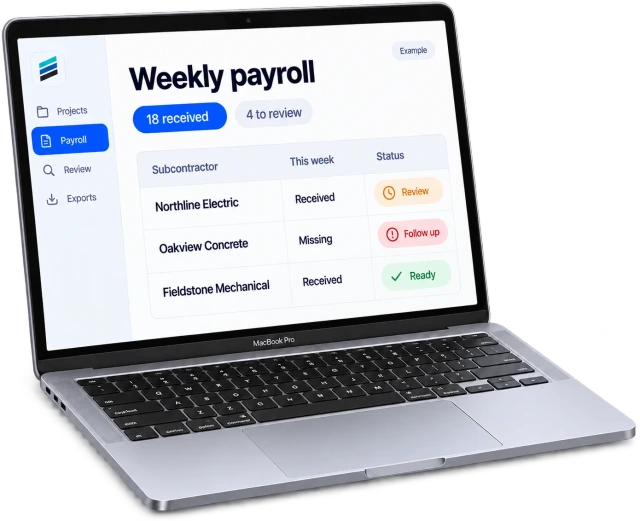
If you are a general contractor, you are usually checking these calculations on someone else's payroll. Buildalytic checks subcontractors' certified payrolls against the wage determination for the job: classification, base rate, fringe, overtime and apprentice rates, and flags each line that does not add up before your team signs off. Your authorized staff still review and certify; Buildalytic does the line-by-line comparison and keeps the correction trail.
One approved example: a San Diego electrical subcontractor that runs prevailing wage work across San Diego County moved its weekly certified payroll cycle to Buildalytic. Its certified payrolls went from 74% on time to 100%, and progress payments held for payroll issues went from $384K to $0. You can read the full San Diego electrical subcontractor story at https://www.buildalytic.com/customers/san-diego-electrical-subcontractor-certified-payroll.
If you want to see what a check finds on your own data, request the free payroll exception report at /payroll-exception-report. Send one week of subcontractor payroll and the job's wage determination, and we will return the exceptions. This guide is general information, not legal advice; confirm specific questions with the contracting agency or your counsel.
Sources: Buildalytic: Prevailing wage compliance software; Buildalytic: A San Diego electrical subcontractor ends $384K in payroll-related payment holds
Common questions
How do you calculate prevailing wage?
Find the wage determination incorporated in the contract, pick the classification for the work performed, and multiply hours by base rate plus fringe. For overtime hours, pay 1.5 × base plus the fringe at straight time. Subtract any annualized plan credit from the fringe and pay the rest in cash.
Is fringe included in prevailing wage overtime?
Under federal rules, no. Fringe contributions and cash paid in lieu of fringe are excluded from the overtime rate, so an overtime hour is 1.5 × base + fringe. Some state determinations print their own overtime rates, which you follow on those jobs.
How do I find my prevailing wage?
Look up the wage determination for your project's county and type of construction, then find your classification. On federal jobs it is on SAM.gov and must be posted at the job site. In California, use the DIR general determinations; New York and Washington publish their own schedules.
Is there a prevailing wage calculator for California?
You can use Buildalytic's free prevailing wage calculator with the basic rate and employer payments from the California DIR determination for your craft and county. Enter daily overtime hours as overtime, and where the determination prints a different overtime rate, use the printed rate.
Can I pay prevailing wage fringe benefits in cash?
Yes. Federal rules allow fringe to be paid in cash, to bona fide plans, or a mix, as long as the total meets the fringe rate. Show cash in lieu of fringe separately from the base rate so it is not multiplied for overtime.
How are apprentices paid on prevailing wage jobs?
Registered apprentices are paid the percentage of the journeyworker base rate set by their program for their step, plus the fringe the program specifies, or the full fringe if the program is silent. Unregistered workers, and apprentices over the ratio, get the full journeyworker rate.
What is a prevailing wage fringe benefits calculator used for?
It converts a yearly benefit cost into an hourly credit by dividing by all hours worked in the year. Buildalytic's free fringe benefit annualization calculator does this and shows the cash still owed when the credit is less than the fringe rate.
Sources and editorial notes
- eCFR: 29 CFR 5.5, contract provisions and related matters (checked November 2026)
- eCFR: 29 CFR 5.31, meeting wage determination obligations (checked November 2026)
- eCFR: 29 CFR 5.32, overtime payments (checked November 2026)
- eCFR: 29 CFR 5.25, rate of contribution or cost for fringe benefits (checked November 2026)
- Federal Register: Updating the Davis-Bacon and Related Acts Regulations, 88 FR 57526, August 23, 2023 (checked November 2026)
- AGC: Court vacates key Davis-Bacon rule provisions, June 24, 2026 (checked November 2026)
- U.S. Department of Labor: Davis-Bacon and Related Acts, construction (checked November 2026)
- SAM.gov: Wage determinations (checked November 2026)
- California DIR: General prevailing wage determinations (checked November 2026)
- California Code of Regulations, Title 8, section 16100: duties of the awarding body, including overtime under Labor Code 1815 (checked November 2026)
- California DIR: Frequently asked questions, prevailing wage (checked November 2026)
- New York State Department of Labor: Public work and prevailing wage (checked November 2026)
- Washington L&I: Prevailing wage rates (checked November 2026)
- Buildalytic: Prevailing wage compliance software
- Buildalytic: A San Diego electrical subcontractor ends $384K in payroll-related payment holds
Prepared with AI assistance. Reference date: 2026-11-22. Worked scenarios use typical figures and are not customer results. Product details can change; confirm the current scope and terms before rollout.