
The short answer
On Massachusetts prevailing wage projects, every contractor and subcontractor sends certified payroll to the awarding authority every week, by first-class mail or email, under M.G.L. c.149 section 27B. Each weekly package includes the payroll records, a signed Weekly Statement of Compliance and copies of apprentice ID cards. Within 15 days of finishing its work, each employer also sends a final statement of compliance. There is no state filing portal.
What to take away
- Certified payroll goes to the awarding authority, weekly, by first-class mail or email.
- Each week needs a signed Weekly Statement of Compliance and a copy of each working apprentice's ID card.
- A final statement of compliance is due within 15 days after you finish your part of the work.
- Payroll records are open to any interested party who asks the awarding authority in writing.
What section 27B requires
Every contractor, subcontractor or public body on a covered project keeps records of each worker's name, address, occupational classification, hours worked and wages paid, and submits them weekly to the awarding authority as certified payroll. Each weekly submission includes a statement signed by the employer that the records are correct and showing the rate paid to each worker.
A 2014 amendment, effective June 24, 2014, allowed submission by email and required the signed statement with every weekly submission. DLS updated its model forms at that time.
Sources: M.G.L. c.149, section 27B (checked November 2026); Mass.gov, Prevailing wage notices
The two DLS forms
DLS publishes model forms on its Prevailing Wage Program page. Using them is the simplest way to cover what section 27B requires.
| Form | Use | Where |
|---|---|---|
| Weekly Certified Payroll Report | The weekly payroll records for each worker | DLS Prevailing Wage Program page |
| Weekly Statement of Compliance | Signed by the employer and sent with each weekly report | DLS Prevailing Wage Program page |
Sources: Mass.gov, DLS Prevailing Wage Program; Mass.gov, Prevailing wage for contractors
How to file each week, step by step
In plain terms, from section 27B and the Attorney General's guidance for contractors:
- Get the DLS wage schedule for the project from the awarding authority. DLS does not issue it to contractors directly.
- Each week, complete the payroll for every covered worker: name, address, classification, hours and wages. The DLS Weekly Certified Payroll Report works.
- Sign the Weekly Statement of Compliance.
- Attach a copy of the ID card for every apprentice who worked that week, and OSHA 10 proof the first time a worker appears on projects over $10,000.
- Send the package to the awarding authority by first-class mail or email.
- Within 15 days of finishing your part of the work, send the final statement of compliance.
Sources: M.G.L. c.149, section 27B (checked November 2026); Mass.gov, Prevailing wage for contractors
Apprentices and OSHA 10 on the payroll
For every week an apprentice works, attach a photocopy of the apprentice's ID card. The Attorney General's guidance also calls for OSHA 10 documentation on the certified payroll the first time a worker is listed on projects over $10,000. Missing cards are easy to fix in the week they happen and hard to rebuild later.
Sources: M.G.L. c.149, section 27B (checked November 2026); Mass.gov, Prevailing wage for contractors
The final statement of compliance
Within 15 days after completing its portion of the work, each contractor and subcontractor gives the awarding authority a signed statement that all workers were paid the rates set under sections 26 and 27. Primes should track this for every sub, because the awarding authority looks for one from each employer.
Sources: M.G.L. c.149, section 27B (checked November 2026); Mass.gov, Prevailing wage for awarding authorities
Who can see your payroll, and how long to keep it
Copies of payroll records and compliance statements are open for inspection and copying by any interested party who files a written request with the awarding authority. On request, records go to the Attorney General signed under the penalties of perjury, and DLS may inspect them at any reasonable time.
Contractors keep the records for 3 years from completion of the contract. Awarding authorities keep the weekly records for 3 years after final payment.
Sources: M.G.L. c.149, section 27B (checked November 2026); Mass.gov, Guide to the prevailing wage law for awarding authorities
Penalties
Section 27C sets criminal and civil penalties.
| Type | First offense | Subsequent |
|---|---|---|
| Willful violation | Up to $25,000 and/or 1 year | Up to $50,000 and/or 2 years |
| Non-willful violation | Up to $10,000 and/or 6 months | Up to $25,000 and/or 1 year |
| Civil citation | Up to $25,000 per violation; up to $15,000 with no prior citation, or $7,500 without specific intent | Debarment rules apply after repeated citations |
Sources: M.G.L. c.149, section 27C
Weekly checklist
Before each package goes out:
| Check | Why it matters |
|---|---|
| Rates match the DLS schedule for the project | Underpayment is the core violation |
| Weekly Statement of Compliance signed | Required with every weekly submission |
| Apprentice ID cards attached for this week | Required for every week an apprentice works |
| OSHA 10 proof for new workers | Required the first time a worker is listed |
| Sent to the awarding authority, not DLS | Section 27B names the awarding authority |
How Buildalytic helps
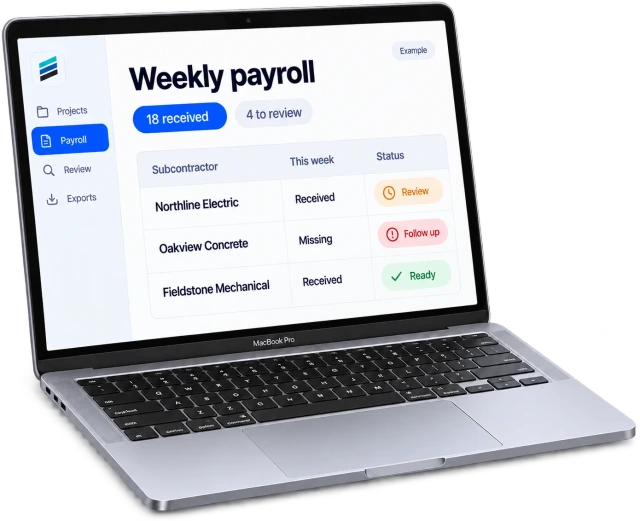
Buildalytic collects and reviews certified payrolls for each job. You set up the employers and the weeks each one should report, payroll files land against the right employer and week, and reviewers see what is missing, what is awaiting review and what is marked no work. Brody, Buildalytic's AI teammate, chases missing weeks by call and text with each sub's payroll contact.
For Massachusetts jobs, each sub's weekly package is checked for the signed statement and apprentice cards before it goes to the awarding authority, and Brody follows up on missing weeks and final statements.
Buildalytic does not decide which law applies, and it does not replace the agency's acceptance. Your team still certifies and files. If you want a quick check first, the free payroll exception report at /payroll-exception-report reviews a week of payroll for common exceptions before it goes out.
Common questions
Where do I send Massachusetts certified payroll?
To the awarding authority, weekly, by first-class mail or email. There is no state filing portal.
What is the Weekly Statement of Compliance?
A statement signed by the employer that the records are correct and showing each worker's rate. It goes with every weekly payroll. DLS publishes a model form.
When is the final statement of compliance due?
Within 15 days after you complete your portion of the work.
Is my certified payroll a public record?
Copies are open to any interested party who files a written request with the awarding authority.
How long do I keep the records?
3 years from completion of the contract.
Sources and editorial notes
- M.G.L. c.149, section 27B (checked November 2026)
- M.G.L. c.149, section 27C
- Mass.gov, DLS Prevailing Wage Program
- Mass.gov, Prevailing wage for contractors
- Mass.gov, Prevailing wage for awarding authorities
- Mass.gov, Guide to the prevailing wage law for awarding authorities
- Mass.gov, Prevailing wage notices
Prepared with AI assistance. Reference date: 2026-11-23. Worked scenarios use typical figures and are not customer results. Product details can change; confirm the current scope and terms before rollout.