
The short answer
Certified payroll reporting means sending a weekly payroll with a signed Statement of Compliance for every week of covered work. On federal Davis-Bacon jobs it goes to the contracting agency, or to the owner or sponsor that forwards it, and the prime is responsible for every sub's payroll. About half the states add their own law, form, portal and schedule, from California's monthly eCPR to Oregon's WH-38 due by the fifth business day of the next month.
What to take away
- Federal certified payroll is weekly, for each week of covered work, with a signed Statement of Compliance. WH-347 is optional; the information is not.
- The prime contractor is responsible for submitting every subcontractor's payroll, at every tier.
- By our state guides, 28 states have a prevailing wage law with their own reporting rules; 8 of them run a statewide electronic portal such as DIR eCPR, PWIA, MPWR or LCPtracker.
- Keep certified payrolls for at least 3 years after the prime contract's work is complete, and check the state rule, which may run separately.
How certified payroll reporting works
Certified payroll reporting is how a contractor proves it paid prevailing wages on a covered public job. Each week the contractor sends a copy of its payroll for the project, listing every laborer and mechanic, their classification, hours, rates, fringe benefits, deductions and net pay, together with a signed statement that the information is correct and the required rates were paid. That signed statement is what makes the payroll certified.
There are two layers. On federally funded or assisted construction covered by the Davis-Bacon and Related Acts, the federal contract clauses in 29 CFR 5.5 set the rules. On state and local public works, a state prevailing wage law may add its own form, portal, recipient and schedule. Some jobs are covered by both, and then both sets of reports are due.
This guide covers the federal rules first, then gives a state-by-state table for all 50 states, the District of Columbia and five territories. Every jurisdiction in the tables also has a detailed state guide on this site at /certified-payroll/ followed by the state name, for example /certified-payroll/oregon or /certified-payroll/new-york, with the statute, agency, forms and sources behind each row.
Federal statements in this guide were checked November 2026 against the DOL Form WH-347 page and the current text of 29 CFR 5.5(a)(3). State rows summarize our state guides. This is general information, not legal advice. Your contract, the awarding agency's instructions and any state rule updates control, so confirm before you rely on a deadline.
Sources: U.S. Department of Labor, Form WH-347 page (checked November 2026); 29 CFR 5.5, Contract provisions and related matters (eCFR, checked November 2026)
Federal certified payroll reports: what, when and to whom
Frequency. The contract clause in 29 CFR 5.5(a)(3)(ii)(A) says the contractor or subcontractor must submit certified payrolls weekly, for each week in which any covered work is performed. A week with no covered work does not require a federal payroll, though many primes ask for a no-work statement to keep the sequence clean.
Recipient. Payrolls go to the federal agency when it is a party to the contract. When it is not, which is common on grant-funded and assisted projects, they go to the applicant, sponsor, owner or other entity that maintains the records, which transmits them to the federal agency. That is why a city, housing authority or state DOT often collects payrolls on a federally assisted job.
Responsibility. The same clause makes the prime contractor responsible for the submission of all certified payrolls by all subcontractors. A sub's late payroll is the prime's problem as well as the sub's.
Format. DOL's WH-347 page, checked November 2026, says use of Form WH-347 is optional, but the weekly payroll information is required. The regulation allows WH-347 or any other format that contains all of the required information. The DOL page lists OMB Control No. 1235-0008, expiring 01/31/2028. Each weekly payroll gets a sequential payroll number starting at 1.
Privacy. Weekly transmittals must not include full Social Security numbers, home addresses, phone numbers or email addresses. An individually identifying number, such as the last four digits of the worker's Social Security number, is enough. A prime may still require a sub to give it the full details for its own records.
Electronic systems. The regulation lets a contracting agency or prime permit or require electronic submission, as long as the system uses a legally valid electronic signature, lets the contractor, the agency and DOL access the payrolls for at least 3 years after the prime contract's work is done, and allows another method for contractors who cannot use it. That is the basis for the portals agencies use, such as LCPtracker on Colorado state jobs and NDDOT federal-aid work, Elation Systems on South Dakota DOT jobs and WisDOT's CRCS in Wisconsin.

Sources: U.S. Department of Labor, Form WH-347 page (checked November 2026); 29 CFR 5.5, Contract provisions and related matters (eCFR, checked November 2026)
The Statement of Compliance on every certified payroll report
Every federal certified payroll must come with a Statement of Compliance signed by the contractor or subcontractor, or by its agent who pays or supervises the payment of the workers. Under 29 CFR 5.5(a)(3)(ii)(C) it certifies three things: that the payroll contains the required information and the underlying records are being kept and are correct and complete; that each worker was paid the full weekly wages earned with no rebates and only permissible deductions; and that each worker was paid at least the wage determination's rates and fringe for the classification of work actually performed.
The certification on page 2 of WH-347 satisfies this requirement when properly executed. The signature must be an original handwritten signature or a legally valid electronic signature. Falsifying the certification can lead to civil or criminal prosecution under 18 U.S.C. 1001 and 31 U.S.C. 3729.
State forms carry their own versions. Oregon requires the WH-38 certified statement, Pennsylvania's LLC-25 requires notarization on the first and last submissions, Alaska requires state Form 07-6058 with an original signature, and Minnesota requires the payroll to be signed under oath by an owner or officer. A WH-347 signature page does not automatically satisfy a state that has its own statement. For the line-by-line mechanics of the federal form, see our WH-347 guide.
Sources: 29 CFR 5.5, Contract provisions and related matters (eCFR, checked November 2026); U.S. Department of Labor, Form WH-347 page (checked November 2026)
States with statewide certified payroll portals
These eight states have a prevailing wage law and require filing through a statewide electronic system run by the labor department or, in Colorado, through LCPtracker. Filing to the portal is often in addition to whatever the prime or awarding agency asks for, so check both.
| Jurisdiction | State law | Filing system or form | Where to file | How often |
|---|---|---|---|---|
| California | Yes, Labor Code 1720 and following | DIR eCPR, online form or XML upload | DIR, directly from each contractor and sub; some LCP and PLA projects exempt | At least monthly, and within 30 days after final work |
| Washington | Yes, chapter 39.12 RCW | Weekly reports in L&I's PWIA system (My L&I account) | L&I PWIA | Filed online at least once a month |
| Maryland | Yes, State Finance and Procurement 17-201 and following | WH-347 or equivalent, uploaded to the Prevailing Wage Portal | Maryland Labor portal; register first; prime submits subs' payrolls | Within 14 calendar days after each payroll period |
| Illinois | Yes, 820 ILCS 130 | IDOL Certified Transcript of Payroll Portal (Illinois Public ID) | IDOL portal | Monthly, by the 15th, for the prior month |
| New York | Yes, Labor Law Article 8 | DOL Certified Payroll portal (MPWR); NYC public work uses the city's database | NYSDOL portal with a NY.gov account | At least every 30 days; report no-work weeks |
| New Jersey | Yes, N.J.S.A. 34:11-56.25 and following | MW-562 certification or its NJ Wage Hub equivalent | Both the awarding public body and the NJ Wage Hub | Each payroll period, within 10 days of payday |
| Colorado | Yes, C.R.S. 24-92-201 and following | LCPtracker, with fringe statement and deduction consents | LCPtracker; prime approves subs, then the agency accepts or rejects | Weekly |
| Michigan | Yes, Act 10 of 2023 | LEO certified payroll database through LCPtracker, since April 2, 2026 | LEO; contractors already reporting to MDOT on a state project are exempt | Within 10 days after each pay period |
Sources: California DIR, Certified payroll reporting; Washington RCW 39.12.120, Certified payroll records; New York State Department of Labor, Electronic Payroll Submission; Illinois Department of Labor, Certified Transcript of Payroll; NJDOL Wage and Hour Compliance, NJ Wage Hub FAQ; Colorado Office of the State Architect, Prevailing Wage and Apprenticeship; Michigan LEO, Prevailing Wage; Maryland Department of Labor, Certified Payroll Requirements
States where certified payroll goes to the awarding agency
These 20 states have a prevailing wage law, but certified payroll is filed with the awarding agency, the contracting authority or a named coordinator rather than a statewide portal. Several set no schedule and leave it to the contract. Virginia and Wyoming do not ask for routine weekly payroll filings at all.
| Jurisdiction | State law | Filing system or form | Where to file | How often |
|---|---|---|---|---|
| Oregon | Yes, ORS 279C.800 to 279C.870 | WH-38 or own format with the WH-38 statement; WH-347 alone is not enough | The public agency | Weekly statements, submitted monthly by the fifth business day |
| Pennsylvania | Yes, 43 P.S. 165-1 and following | Form LLC-25; statement notarized on first and last submissions | The awarding public body | Weekly |
| Massachusetts | Yes, M.G.L. c. 149, sections 26 to 27H | Weekly payroll with a signed statement | Awarding authority, by mail or email; not DLS | Weekly |
| Texas | Yes, Government Code Chapter 2258 | No state form; TWC says WH-347 would suffice | The awarding public body, per its contract | Set by the contract |
| Alaska | Yes, AS 36.05 | Sworn payroll plus Form 07-6058 with an original signature | Regional Wage and Hour office: mail, hand delivery or LSS-Online; no email | Every second week, before Friday |
| Connecticut | Yes, CGS 31-53 | Form WWS-CPI or equivalent, with statement of compliance | Contracting agency, or DECD or the developer where applicable | Monthly, as a copy of weekly records |
| Delaware | Yes, 29 Del. C. 6960 | State sworn payroll form with fringe documentation | The awarding agency, or as the contract directs | Weekly |
| Hawaii | Yes, HRS Chapter 104 | Any format plus fringe reporting form; DAGS form optional | Contracting agency; GC submits all subs' payrolls | Weekly |
| Maine | Yes, 26 M.R.S. 1304 to 1317 | MDOL Certified Payroll Form or equivalent, with Statement of Compliance | General contractor and letting agency, or assisting state agency | Each payroll period, plus a monthly wage record copy |
| Minnesota | Yes, Minn. Stat. 177.41 to 177.44 | DLI form or equivalent, signed under oath by an owner or officer | Contracting authority and project owner | Every two weeks; contracts say within 14 days |
| Missouri | Yes, RSMo 290.210 to 290.340 | Certified payroll (Form LS-57 available); PW-4 affidavit before final payment | The public body running the project | Set by the contract |
| Montana | Yes, MCA Title 18, Chapter 2, Part 4 | Signed weekly payroll; MDT uses its own electronic system | As the contract requires | Weekly |
| Nevada | Yes, NRS Chapter 338 | Monthly record with PWP number; nonperformance report for idle months | Awarding public body; subs may route through the prime by the 10th | Monthly, 15 days after month end |
| New Mexico | Yes, NMSA 13-4-10 to 13-4-17 | Weekly payroll with fringe statement; paperwork in the PWAA system | Contracting agency; prime submits all subs' payrolls | Updated weekly, copies sent monthly |
| Ohio | Yes, ORC 4115.03 to 4115.16 | Certified payroll | Prevailing wage coordinator named by the public authority | First within two weeks of first payday, then monthly |
| Rhode Island | Yes, RIGL chapter 37-13 | DLT RI Certified Weekly Payroll form and RI Statement of Compliance | Awarding authority; DLT within 10 days of a request | Monthly, for the prior month |
| Tennessee | Yes, state highway projects (TCA 12-4-401 and following) | No state form or schedule | The awarding state agency, per its contract | Set by the contract |
| Vermont | Yes, State projects (29 V.S.A. 161(b)) | Not set by statute | The awarding agency, per the contract | Set by the contract |
| Virginia | Yes, Va. Code 2.2-4321.3 | Pay Scale Certification to DOLI under oath; no routine weekly filing | DOLI Prevailing Wage, by email or mail | Once, after award |
| Wyoming | Yes, W.S. 27-4-401 to 27-4-413 | Federally certified format showing residency, on request | DWS or the contracting entity, when requested | On written request |
Sources: Oregon BOLI, Prevailing wage; U.S. Department of Labor, State Prevailing Wage Laws
States without a prevailing wage law, DC and the territories
These 22 states have no state prevailing wage law for general public works, so certified payroll is a federal requirement only, on Davis-Bacon and Related Act jobs. A few state DOTs still require electronic filing on federal-aid highway work. The District of Columbia and the territories follow the federal rules, with local twists noted below.
| Jurisdiction | State law | Filing system or form | Where to file | How often |
|---|---|---|---|---|
| Alabama | No, repealed 1980 | Davis-Bacon jobs only; WH-347 optional | Federal agency, or the sponsor or owner that forwards it | Weekly on Davis-Bacon work |
| Arizona | No, repealed 1984; ARS 34-321 bars local mandates | Davis-Bacon jobs only; WH-347 optional | Federal agency, or the sponsor or owner that forwards it | Weekly on Davis-Bacon work |
| Arkansas | No, repealed 2017 | Davis-Bacon jobs only; WH-347 optional | Federal agency, or the sponsor or owner that forwards it | Weekly on Davis-Bacon work |
| Florida | No, repealed 1979 | Davis-Bacon jobs only; WH-347 optional | Federal agency, or the sponsor or owner that forwards it | Weekly on Davis-Bacon work |
| Georgia | No | Davis-Bacon jobs only; WH-347 optional | Federal agency; DCA CDBG payrolls go to the grant recipient | Weekly on Davis-Bacon work |
| Idaho | No, repealed 1985 | Davis-Bacon jobs only; WH-347 optional | Federal agency, or the sponsor or owner that forwards it | Weekly on Davis-Bacon work |
| Indiana | No, repealed 2015 | Davis-Bacon jobs only; WH-347 optional | Federal agency, or the sponsor or owner that forwards it | Weekly on Davis-Bacon work |
| Iowa | No | Davis-Bacon jobs only; WH-347 optional | Federal agency, or the sponsor or owner that forwards it | Weekly on Davis-Bacon work |
| Kansas | No, repealed 1987 | Davis-Bacon jobs only; WH-347 optional | Federal agency, or the sponsor or owner that forwards it | Weekly on Davis-Bacon work |
| Kentucky | No, repealed 2017 | Davis-Bacon jobs only; WH-347 optional | Federal agency, or the sponsor or owner that forwards it | Weekly on Davis-Bacon work |
| Louisiana | No, repealed 1988 | Davis-Bacon jobs only; WH-347 optional | Federal agency, or the sponsor or owner that forwards it | Weekly on Davis-Bacon work |
| Mississippi | No | Davis-Bacon jobs only; WH-347 optional | Federal agency, or the sponsor or owner that forwards it | Weekly on Davis-Bacon work |
| Nebraska | No rate-setting law; 1939 fair labor standards law | Davis-Bacon jobs only; WH-347 optional | Bidders file a compliance statement; Davis-Bacon payrolls to agency or sponsor | Weekly on Davis-Bacon work |
| New Hampshire | No, repealed 1985 | Davis-Bacon jobs only; WH-347 optional | Federal agency, or the sponsor or owner that forwards it | Weekly on Davis-Bacon work |
| North Carolina | No | Davis-Bacon jobs only; WH-347 optional | Federal agency, or the sponsor or owner that forwards it | Weekly on Davis-Bacon work |
| North Dakota | No | NDDOT federal-aid jobs: LCPtracker, no paper | LCPtracker; counts as submitted once the prime approves | Weekly on Davis-Bacon work |
| Oklahoma | No, repealed 2015 | Davis-Bacon jobs only; WH-347 optional | Federal agency, or the sponsor or owner that forwards it | Weekly on Davis-Bacon work |
| South Carolina | No | Davis-Bacon jobs only; WH-347 optional | Federal agency, or the sponsor or owner that forwards it | Weekly on Davis-Bacon work |
| South Dakota | No general law; SDDOT applies labor provisions by contract | SDDOT jobs: Elation Systems with SDDOT Statement of Compliance | Elation for SDDOT jobs let since June 5, 2019; otherwise as funding agency names | Weekly, within seven days after wages are paid |
| Utah | No, repealed 1981 | Davis-Bacon jobs only; WH-347 optional | Federal agency, or the sponsor or owner that forwards it | Weekly on Davis-Bacon work |
| West Virginia | No, repealed 2016; Jobs Act still applies | Jobs Act payroll records; WH-347 on Davis-Bacon jobs | Division of Labor for Jobs Act; agency for Davis-Bacon | Weekly on Davis-Bacon work |
| Wisconsin | No, repealed 2015 and 2017 | WisDOT federal-aid jobs: CRCS; WH-347 optional elsewhere | CRCS, or the contracting or funding agency | Weekly on Davis-Bacon work |
| District of Columbia | Federal Davis-Bacon applies directly | WH-347 optional; First Source reporting via DOES and LCPtracker | Contracting agency; First Source as the agreement directs | Weekly; First Source monthly |
| Puerto Rico | No general statute confirmed; OE-2022-014 wage floor | WH-347 optional; no territorial form confirmed | Federal agency, or sponsor, owner or territorial agency | Weekly on Davis-Bacon work |
| Guam | Yes, 5 GCA 5801 to 5805 for GovGuam service contracts | WH-347 optional | Federal agency, or sponsor, owner or territorial agency | Weekly on Davis-Bacon work |
| U.S. Virgin Islands | See the state guide | WH-347 optional | Federal agency, or sponsor, owner or territorial agency | Weekly on Davis-Bacon work |
| American Samoa | No territorial law confirmed | WH-347 optional | Federal agency, or sponsor, owner or territorial agency | Weekly on Davis-Bacon work |
| Northern Mariana Islands | No CNMI statute confirmed; Davis-Bacon applies | WH-347 optional | Federal agency, or sponsor, owner or territorial agency | Weekly on Davis-Bacon work |
Sources: U.S. Department of Labor, State Prevailing Wage Laws; SDDOT, Certified Payrolls, let after 6/5/19; NDDOT, Special Provision, Mandatory Use of Automated Certified Payroll
When federal and state certified payroll both apply
A federally assisted project in a state with its own law can trigger two reporting streams. On a job like that in Washington, for example, the contractor may owe weekly federal payrolls to the agency or sponsor and also file in L&I's PWIA system at least monthly. In California, the federal payroll goes to the agency while the eCPR goes directly to DIR. Sending one does not satisfy the other.
The practical rule: list every reporting obligation at the start of the job, with the recipient, the format and the deadline for each. Our Davis-Bacon vs state prevailing wage guide covers which rate applies when both laws cover the same work; this guide is about where the paperwork goes.
Who files certified payroll reports: primes, subs and lower tiers
Every employer with laborers or mechanics on the covered site files its own certified payroll. That includes the prime, each first-tier sub and every lower-tier sub, down to a two-person crew that is on site for one week. Federal clauses must flow down to every subcontract, and each sub must flow them to its own subs.
On federal jobs, payrolls usually travel up the chain: the lower-tier sub sends to the sub that hired it, which forwards to the prime, which submits the package to the agency or sponsor. Several states change the route. California's DIR requires each contractor and subcontractor to submit directly to the Labor Commissioner. Washington requires each contractor to file in PWIA. Maryland, Hawaii and New Mexico have the prime submit its subs' payrolls. In Colorado, the prime approves sub payrolls in LCPtracker before the agency reviews them, and on NDDOT federal-aid jobs a payroll counts as submitted only after the prime's approver approves it.
Our certified payroll for subcontractors guide covers the sub's weekly cycle in detail. For a prime, the job is to know every employer expected on site, every week each one should report, and which weeks are still missing.
Sources: 29 CFR 5.5, Contract provisions and related matters (eCFR, checked November 2026); California DIR, Certified payroll reporting; Washington RCW 39.12.120, Certified payroll records; Colorado Office of the State Architect, Prevailing Wage and Apprenticeship; NDDOT, Special Provision, Mandatory Use of Automated Certified Payroll
Certified payroll deadlines by schedule
Deadlines fall into a few patterns. The federal rule is weekly, and the subcontract or prime usually sets the exact day each week's payroll is due. State schedules vary widely, and preparing a weekly record is not the same as submitting it. Oregon is the clearest example: you prepare a certified statement for each week a worker is employed, then submit to the public agency at least monthly, by the fifth business day of the following month.
The list below groups the schedules from the tables above. Where a state says monthly, the weekly records still have to exist and be accurate.
- Weekly: federal Davis-Bacon work, Colorado, Pennsylvania, Massachusetts, Delaware, Hawaii and Montana.
- Within a set number of days after each pay period: New Jersey and Michigan (10 days), Maryland (14 days) and South Dakota DOT jobs (7 days after wages are paid).
- Every two weeks: Alaska (before the Friday of every second week) and Minnesota.
- Monthly: California eCPR (at least monthly), Washington PWIA (at least monthly), New York (at least every 30 days), Illinois (by the 15th), Oregon (fifth business day), Nevada (15 days after month end), Connecticut, Rhode Island, and Ohio after the first report.
- Set by the contract: Texas, Missouri, Tennessee and Vermont.
- On request or once: Wyoming on written request; Virginia's one-time pay scale certification after award.
Sources: Oregon BOLI, Prevailing wage; California DIR, Certified payroll reporting; Illinois Department of Labor, Certified Transcript of Payroll; New York State Department of Labor, Electronic Payroll Submission
Common reasons certified payroll reports get rejected
Most rejections come from a small set of problems that a reviewer can spot on the face of the report. Agencies and primes differ in what they bounce, but these come up across federal and state work.
- Missing or unsigned Statement of Compliance, or a state statement missing where the state requires its own (WH-38 in Oregon, Form 07-6058 in Alaska).
- Wrong classification for the work performed, or one classification used for a worker who did two kinds of work.
- Base rate or fringe below the wage determination in the contract, or the wrong wage determination used.
- Overtime paid at time and a half of the total rate instead of the basic hourly rate, or not paid at all.
- Apprentices paid apprentice rates without proof of registration, or above the program's ratio.
- Gaps in the payroll number sequence, or a missing week with no explanation.
- Full Social Security numbers or home addresses on a weekly transmittal.
- Fringe credit claimed for a plan with no supporting documentation.
- Gross pay, deductions and net pay that do not add up across the row.
- Filed in the wrong place: to the prime only when the state wants direct filing, or to the portal only when the public body also needs a copy, as in New Jersey.
Sources: 29 CFR 5.5, Contract provisions and related matters (eCFR, checked November 2026); NJDOL Wage and Hour Compliance, NJ Wage Hub FAQ
Corrections and amendments
When a payroll is wrong, fix the pay first, then fix the paperwork. Pay the worker the difference, then submit a revised payroll for the same week and payroll number, clearly marked as revised, with a fresh signed Statement of Compliance. Keep the original and the revision together so a reviewer can see what changed and why.
State portals have their own correction tools and their own limits. Washington's PWIA lets you create an amendment on a filed report. California uses a Statement of Non-Performance for a period with no work. Illinois lets you withdraw a filing only for the current month; prior months lock after the 15th. Check your portal's instructions before you file a correction, and keep the agency's receipt for both versions.
Do not wait for the agency to find the error. A self-corrected payroll with back pay already paid is a much easier conversation than a finding during an audit.
Sources: Washington RCW 39.12.120, Certified payroll records; California DIR, Certified payroll reporting; Illinois Department of Labor, Certified Transcript of Payroll
Certified payroll record retention
Federally, 29 CFR 5.5(a)(3)(ii)(G) requires the contractor or subcontractor to preserve all certified payrolls during the work and for 3 years after all the work on the prime contract is completed. The basic payroll records behind them, with full names, Social Security numbers, addresses, classifications, rates, hours and deductions, must be kept for at least the same 3 years under 5.5(a)(3)(i). Note that the clock starts when the prime contract's work ends, not when your own work ends, so a sub that finished early keeps its records longer.
States set their own retention rules. Oregon, for example, requires certified statements to be kept for three years from completion of the contract. Check the state guide for your jurisdiction and keep the longer period when two rules apply. Keep agency receipts and portal confirmations with the payrolls; they are your proof that a report was filed on time.
Sources: 29 CFR 5.5, Contract provisions and related matters (eCFR, checked November 2026); Oregon BOLI, Prevailing wage
Penalties for late, missing or false certified payroll
Federal remedies are real leverage. Under 29 CFR 5.5(a)(2), the agency may withhold from the prime's payments enough to cover unpaid wages owed by the prime or any subcontractor. If a contractor fails to submit required records or make them available, the agency may, after written notice, take action to suspend any further payment, advance or guarantee of funds. Failure to submit records on request can be grounds for debarment under 29 CFR 5.12, and falsifying the Statement of Compliance can lead to prosecution under 18 U.S.C. 1001 and 31 U.S.C. 3729.
State remedies vary by state and can include withheld contract payments, civil penalties and debarment. Each state guide summarizes the rule for that state, with links to the statute. In practice, the first consequence most contractors feel is a held progress payment: the prime or owner will not release money while a payroll week is missing or under correction.
Sources: 29 CFR 5.5, Contract provisions and related matters (eCFR, checked November 2026)
10-point checklist before you submit a certified payroll report
Run this before each week's report leaves the office.
| Check | Done when |
|---|---|
| 1. Right project and recipient | Project name, contract number and recipient match the contract and the state rule |
| 2. Payroll number and week ending | Sequence has no gaps; final payroll is marked as final |
| 3. Every worker listed | Timecards and daily reports reconcile to the payroll |
| 4. Classifications match the work | Split lines for workers in two classifications |
| 5. Rates meet the wage determination | Base rate and fringe checked against the determination in the contract |
| 6. Overtime figured correctly | Premium calculated on the basic hourly rate |
| 7. Apprentices documented | Registration on file and the ratio within the program limit |
| 8. Math and deductions check out | Gross, deductions and net add up; deductions are permissible |
| 9. Privacy protected | Only an identifying number, no full SSN or home address |
| 10. Statement signed and receipt kept | Federal and any state statement signed; agency or portal receipt saved |
How Buildalytic helps
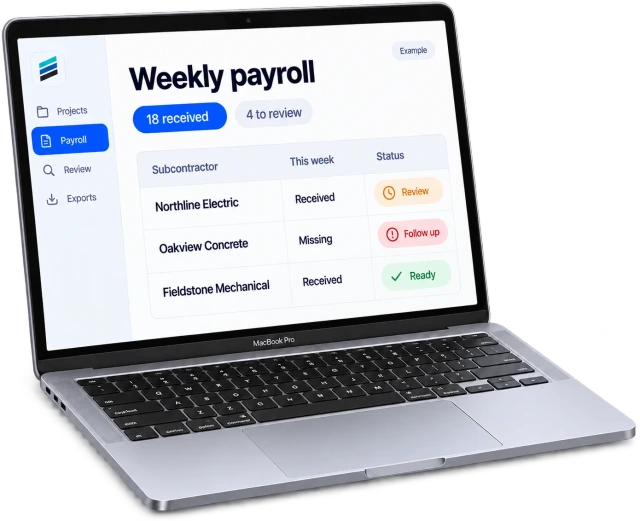
Buildalytic collects and reviews subcontractors' certified payrolls for each job. You set up the employers and the weeks each one should report, payroll files land against the right employer and week, and reviewers see what is missing, what is awaiting review and what is marked no work. Brody, Buildalytic's AI teammate, chases missing weeks by call and text with the sub's payroll contact. Buildalytic does not decide which law applies or replace the awarding agency's acceptance; your team still certifies and files.
One approved customer story: a San Diego electrical subcontractor that runs prevailing wage public works with Brody reports, in its own published results, that "Every certified payroll has gone in on time, up from 74%, and no progress payment has been held for payroll issues, compared with $384K held across three pay applications before." The full story is linked in the sources below.
If you want a quick read on your own payroll first, the free payroll exception report at /payroll-exception-report checks a week of payroll for common exceptions before it goes out.
Sources: Buildalytic customer story, San Diego electrical subcontractor
Common questions
What is certified payroll reporting?
It is the weekly submission of a contractor's project payroll with a signed Statement of Compliance on a prevailing wage job. Federally it is required for each week of covered Davis-Bacon work. Many states add their own form, portal and schedule for state and local public works.
Where do I submit certified payroll reports?
On federal jobs, to the federal agency if it is a party to the contract, otherwise to the applicant, sponsor or owner that forwards them. Subs usually send through the prime. States differ: California, Washington, Illinois, New York and others use a statewide portal, while many states use the awarding agency.
Are certified payroll forms required to be WH-347?
No. DOL says WH-347 is optional; any format with all the required information and a signed Statement of Compliance works on federal jobs. Some states have their own form or statement, such as Oregon's WH-38, Pennsylvania's LLC-25 and Alaska's Form 07-6058, so check the state rule.
How often is certified payroll due for prevailing wage work?
Weekly on federal Davis-Bacon work. State schedules range from weekly to monthly: New Jersey and Michigan within 10 days of each pay period, Maryland within 14 days, Illinois by the 15th of the next month, and Oregon by the fifth business day of the next month.
Which states do not have a prevailing wage law?
Based on our state guides, 22 states have no state prevailing wage law for general public works, including Alabama, Arizona, Florida, Georgia, Indiana, North Carolina, Utah and Wisconsin. Davis-Bacon still applies there on federally funded or assisted projects.
How long do I keep certified payroll records?
Federally, at least 3 years after all work on the prime contract is completed, for both certified payrolls and the basic records behind them. States can set their own period, and you should keep the longer one when both apply.
Do certified payroll reporting services file for me?
Some services prepare and file reports for you; software like Buildalytic helps you collect, review and track them. Either way, the contractor signs the Statement of Compliance and remains responsible for its accuracy.
Sources and editorial notes
- U.S. Department of Labor, Form WH-347 page (checked November 2026)
- 29 CFR 5.5, Contract provisions and related matters (eCFR, checked November 2026)
- U.S. Department of Labor, State Prevailing Wage Laws
- California DIR, Certified payroll reporting
- Oregon BOLI, Prevailing wage
- Washington RCW 39.12.120, Certified payroll records
- Maryland Department of Labor, Certified Payroll Requirements
- Illinois Department of Labor, Certified Transcript of Payroll
- New York State Department of Labor, Electronic Payroll Submission
- NJDOL Wage and Hour Compliance, NJ Wage Hub FAQ
- Colorado Office of the State Architect, Prevailing Wage and Apprenticeship
- Michigan LEO, Prevailing Wage
- SDDOT, Certified Payrolls, let after 6/5/19
- NDDOT, Special Provision, Mandatory Use of Automated Certified Payroll
- Buildalytic customer story, San Diego electrical subcontractor
Prepared with AI assistance. Reference date: 2026-11-23. Worked scenarios use typical figures and are not customer results. Product details can change; confirm the current scope and terms before rollout.