
Certified payroll / Field guide
Montana certified payroll and prevailing wage reporting.
Montana prevailing wage covers public works contracts over $25,000. Rate schedules, weekly certified payroll, the 50 percent resident rule, records and penalties.
Compliance at a glance
Montana prevailing wage and certified payroll rules.
Reviewed November 17, 2026. Each item comes from the agency or statute listed under official sources.
| Law | Montana Code Annotated Title 18, Chapter 2, Part 4, Standard Prevailing Rate of Wages. |
| Agency | Department of Labor and Industry, Compliance and Investigations Bureau. |
| Covered projects | Public works contracts for construction or nonconstruction services over $25,000 let by the state, a county, a city, a school district or another political subdivision. |
| How rates are set | Yearly survey from April through June 30, plus bargaining agreements and prior rates. Building, heavy, highway and nonconstruction schedules are on the department's State Prevailing Wage Rates page. |
| Certified payroll | A signed weekly payroll affirming correct classifications and rates. Cash fringe is shown separately. The department may demand certified copies when a complaint is filed. |
| Where to file | As the contract requires. On a complaint, give payroll records to the department within 5 days. MDT uses its own electronic payroll system. |
| Contractor registration | Since January 1, 2026, construction contractors need a Construction Contractor License from the Department of Labor and Industry under HB 239. No separate prevailing wage registration. |
| Apprentices | Registered or recognized apprentices may be paid a percentage of the journey rate set in their apprenticeship agreement. No state ratio found. |
| Other requirements | Post wages, fringe, travel and per diem by the first day of work. At least 50 percent Montana residents on state construction projects. Pay hourly workers weekly. |
| Record retention | Keep timecards and payroll records for 3 years after the work on each project is completed. |
| Penalties | Back wages plus $25 per day to workers. Up to 20 percent of unpaid wages and fringe, plus fees and costs. Other violations bring $1,000 fines, or $10,000 for gross negligence. |
| Recent changes | HB 239 of 2025 replaced contractor registration with a license from January 1, 2026. Revised 2026 rates are current. Draft 2027 rates took comments before November 15, 2026. |
| Federal overlay | Davis-Bacon applies to federally funded or assisted construction over $2,000 in addition to state law. |
01 / In practice
Know when Montana prevailing wage applies
The Department of Labor and Industry enforces the prevailing wage law in Title 18, Chapter 2, Part 4 of the Montana Code. It applies to public works contracts for construction or nonconstruction services over $25,000. That includes contracts let by the state, a county, a city, a school district or another political subdivision. The prevailing wage is the basic hourly rate plus fringe benefits for each occupation. The department's Compliance and Investigations Bureau handles questions and complaints.
02 / In practice
Use the right rate schedule
The department publishes separate schedules for building construction, heavy construction, highway construction and nonconstruction services. It surveys employers each year from early April through June 30. Construction rates draw on survey data, collective bargaining agreements and the prior year's rates. The 2026 schedules are current. Drafts of the 2027 schedules were posted for comment through November 15, 2026. Contracting agencies must put the schedule in the bid documents and contract. Contracts of 30 months or longer get rate adjustments every 12 months.
Where teams get burned
Most Montana payroll problems are found after the money is gone.
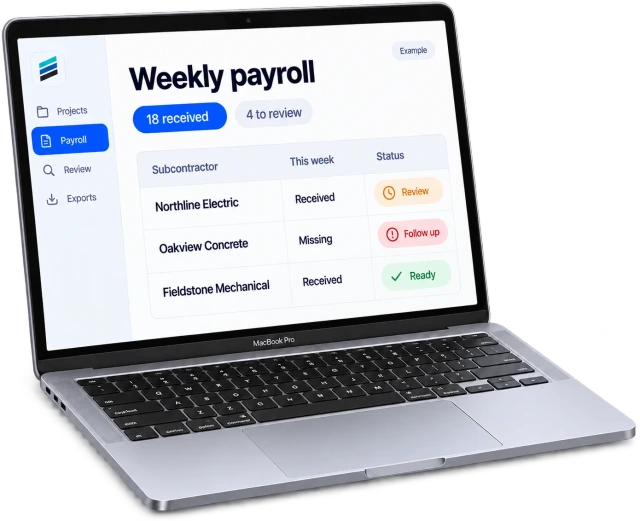
Underpaid fringe, a missing week from one sub or an apprentice over the ratio usually surfaces in an audit or a withheld payment, months later, when the sub has been paid and the crew has moved on. Buildalytic checks every sub's payroll the week it arrives.
| Subcontractor | Payroll | What was flagged | Result |
|---|---|---|---|
| Ridgeline Electric | Week 6 | Electrician paid $46.10 base; determination is $48.20 | Short $84.00 for 40 hours |
| Valley Concrete | Week 6 | Fringe credit $9.50/hr from a health plan, not annualized | Credit should be $6.00/hr |
| Summit Drywall | Week 5 | Payroll not received | Brody called and texted the payroll contact twice |
| Summit Drywall | Week 6 | Three apprentices for one journeyworker; ratio is 1:1 | Two paid the journeyworker rate |
| Northside Mechanical | Week 6 | Worker classified as laborer, daily report shows pipefitting | Ask for split classification hours |
Sample exception report with illustrative subcontractors and rates.
03 / In practice
Classify workers, post rates and hire residents
Classify each worker by the craft or trade performed and pay that rate. Post a legible statement of all wages, fringe benefits, travel and per diem at a prominent spot on the project no later than the first day of work. Keep it up for the whole job. At least 50 percent of each contractor's workers on the project must be bona fide Montana residents. The rule does not apply to projects partly funded with U.S. Department of Transportation federal aid or where federal law prohibits residency preference. Hourly employees must be paid weekly.
04 / In practice
Prepare weekly certified payroll
The department defines certified payroll as a signed copy of the weekly payroll. The employer affirms it is correct and complete, that classifications match the work, and that wages meet the schedule. Fringe benefits paid in cash must be listed separately from base wages. Review each week internally before you sign. Then submit it as your contract requires. State law lets the department demand certified payroll copies when a complaint is filed. The Montana Department of Transportation uses its own electronic payroll system.
05 / In practice
Pay apprentices and fringe benefits correctly
A registered or recognized apprentice may be paid a percentage of the journey rate, as stated in the apprenticeship agreement. Fringe contributions count only if paid irrevocably into a bona fide plan at least quarterly. If you have no plan, pay the full fringe rate in cash on regular paydays. Overtime is one and one-half times the base rate for hours over 40 in a week. Fringe is paid at straight time for all hours.
06 / In practice
Keep records and avoid penalties
Keep timecards and payroll records that show prevailing wage and overtime compliance for three years after the project's work is done. When the department asks for payroll records in a wage complaint, you have five days to provide them. Underpaid workers can recover back wages plus $25 per day. The department can add up to 20 percent of the unpaid wages and fringe, plus fees and costs. Other violations carry fines of $1,000, or $10,000 for gross negligence.
State guides
Certified payroll and prevailing wage rules in every state and territory.
Filing systems, thresholds, rates and deadlines by state, from each state's agency and statutes. Federal Davis-Bacon rules apply on top of state law on federally funded work.
- Federal (Davis-Bacon)
- Alabama
- Alaska
- American Samoa
- Arizona
- Arkansas
- California
- Colorado
- Connecticut
- Delaware
- District of Columbia
- Florida
- Georgia
- Guam
- Hawaii
- Idaho
- Illinois
- Indiana
- Iowa
- Kansas
- Kentucky
- Louisiana
- Maine
- Maryland
- Massachusetts
- Michigan
- Minnesota
- Mississippi
- Missouri
- Montana
- Nebraska
- Nevada
- New Hampshire
- New Jersey
- New Mexico
- New York
- North Carolina
- North Dakota
- Northern Mariana Islands
- Ohio
- Oklahoma
- Oregon
- Pennsylvania
- Puerto Rico
- Rhode Island
- South Carolina
- South Dakota
- Tennessee
- Texas
- US Virgin Islands
- Utah
- Vermont
- Virginia
- Washington
- West Virginia
- Wisconsin
- Wyoming
Compare every state side by side in the prevailing wage laws by state table, or work out a paycheck with the prevailing wage calculator.
Official sources
Start with the agency’s instructions.
Reporting requirements depend on the contract and applicable program. Check the current instructions with the team responsible for your project.
- Montana Department of Labor and Industry · Prevailing Wage FAQs ↗
- Montana Department of Labor and Industry · Prevailing Wage Guide ↗
- Montana Department of Labor and Industry · State Prevailing Wage Rates ↗
- Montana Legislature · MCA 18-2-423 ↗
- Montana Legislature, MCA 18-2-409 ↗
- Montana DLI, Construction Contractor License Program ↗
Sources checked November 17, 2026.
What is the Montana prevailing wage threshold?
Montana prevailing wage applies to public works contracts for construction or nonconstruction services over $25,000. The contract can be let by the state, a county, a city, a school district or another political subdivision. Federal Davis-Bacon rules may also apply when federal money is involved.
How often is certified payroll prepared in Montana?
The department defines certified payroll as a signed copy of the weekly payroll. Hourly employees on public works must be paid weekly. The statute lets the department require certified copies when a complaint is filed. Your contract sets when and where to submit, so confirm with the agency before work starts.
Does Montana require hiring state residents on public works?
Yes. The department says at least 50 percent of each contractor's workers on a public works project must be bona fide Montana residents. The rule does not apply when federal law prohibits it. Contracting agencies must also include a preference for Montana residents in the contract.
How long do I keep Montana prevailing wage records?
The department says to keep timecards and payroll records that show prevailing wage and overtime compliance for three years after the work on each project is completed. Provide payroll records within five days when the department requests them during a wage complaint.
What penalties apply in Montana?
Workers can recover back wages plus $25 per day for each day they were underpaid. The state can add a penalty of up to 20 percent of the unpaid wages and fringe benefits, plus attorney, audit and court costs. Other violations can bring a $1,000 fine, or $10,000 for gross negligence.
Start with one project.
Bring your reporting requirements and a sample payroll. We’ll walk through collection, review and the final handoff with your team.